Business ETC uses cookies. By continuing to browse this site you are agreeing to our use of cookies. Click here to find out more »
Dublin: 9 °C Friday 24 May, 2013

IMF head warns of ‘acute stress’ in Europe

Christine Lagarde calls for bailout funds to be given to banks directly rather than countries being saddled with the debt – while Italy’s prime minister warns leaders have one week to save the eurozone.

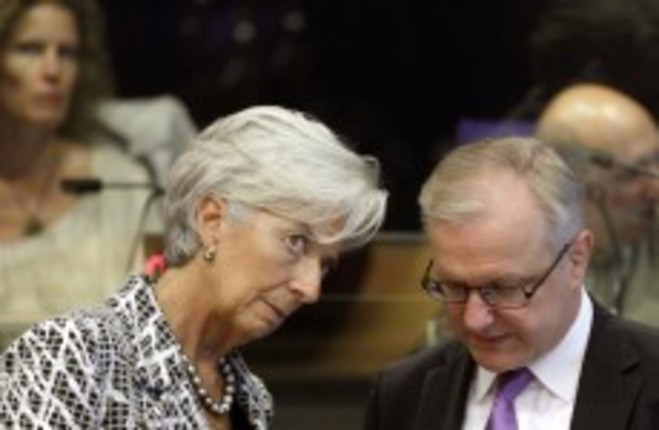
Managing Director of the International Monetary Fund Christine Lagarde, left, speaks with European Commissioner for the Economy Olli Rehn
Image: Virginia Mayo/AP/Press Association Images

THE HEAD OF the International Monetary Fund warned today that the euro is under “acute stress” and piled pressure on Germany by advocating a series of measures to pull Europe out of its crisis that its Chancellor Angela Merkel has strenuously opposed.

Christine Lagarde urged leaders of the 17 countries that use the euro to consider jointly issuing debt, aiding troubled banks directly and perhaps relaxing strict austerity conditions on countries that have received aid — all measures that Merkel, the leader of the eurozone’s largest and most powerful economy, has resisted.

‘We hope wisdom will prevail’

But Lagarde, speaking after a meeting in Luxembourg of the finance ministers of the 17 countries that use the euro, said the IMF had found the situation in Europe to be dire.

“We are clearly seeing additional tension and acute stress applying to both banks and sovereigns in the euro area,” she said late Thursday.

Asked what Germany would think of her suggestions, she smiled and said “We hope wisdom will prevail.”

Lagarde issued her warning in the lead-up to a week that promises to be unusually active in the fight to save Europe’s common currency.

‘One week to save the eurozone’

Italy’s prime minister Mario Monti has warned of disastrous consequences of any failure during the upcoming meeting between EU leaders - saying they have just “one week” to save the eurozone, the Guardian reports.

Today, Merkel will travel to Rome to meet Italian Premier Mario Monti and the leaders of France and Spain in Rome in an effort to forge a common strategy to save the currency that some, Merkel included, consider essential to preserving the European Union itself.

By next Monday, Spain will make a formal request for financial assistance to bail out its teetering banks, according to Jean-Claude Juncker, the Luxembourg Prime Minister who is also president of the eurogroup of finance ministers. Earlier Thursday, Spain announced that independent auditors had found that its banks would need up to €62 billion to protect themselves from financial shocks.

Speaking after the eurogroup meeting, Juncker said the other ministers had “invited Spain to pursue [a] clear and ambitious strategy, which needs to be implemented swiftly and communicated early.”

Budget reform in Greece

On Monday, the IMF, the European Union and the European Central Bank — the so called “troika” overseeing Greece’s bailout — will send representatives to Greece to begin a review of the country’s progress in reforming its budget. Some European officials have said that a loosening of the harsh budgetary requirements that have sent Greece’s economy into a downward spiral could be considered.

Later in the week, on Thursday and Friday, leaders of the 27 countries that are members of the European Union will gather in Brussels for a high-stakes meeting on how to save the euro — and their intimately intertwined national economies.

That meeting will take place amid worldwide fears that an economic crack-up in Europe could drag down the entire global economy. Europe is a substantial trading partner with the rest of the world. Any deep recession in Europe will be felt in the order books of other leading economies — including the US.

G-20 summit

The IMF chief’s backing for solutions that have been opposed by the German government comes amid increased pressure from a growing number of international leaders for Merkel and the eurozone to find a comprehensive solution to the debt crisis rather than continuing to take piecemeal measures that provide only temporary relief. At this week’s G-20 summit of world economic powers in Los Cabos, Mexico, politicians, including US President Barack Obama, called on Europe to do what was necessary.

One of Lagarde’s recommendations for Europe was that eurozone leaders should consider issuing bonds or debt “in some form” backed by governments of all member countries— an idea Germany has vehemently opposed because, while it would immediately ease pressure on countries like Spain, it would put German taxpayers on the hook for foreign debts and increase Germany’s cost of borrowing.

In addition, Lagarde said it was necessary to break “the negative feedback loop” that occurs when governments take on more debt to bail out their banks, and she called on Europe’s two emergency bailout funds to shore up shaky banks directly. She also urged the European Central Bank to adopt a more relaxed monetary policy.

Additional reporting by Jennifer Wade

Read next:

Comments (24 Comments)

  • Dave 22/06/12 #

    The thing is, conspiracy theorists would suggest that we are being fed a diet of fear so that we’ll just accept whatever solution is forced on us. Its got to the stage now where personally, i dont bat an eyelid no matter what the headline. You just get immune to it. Its not frightening anymore, just f****** annoying.

    Reply
  • Dave 22/06/12 #

    There’s acute bleedin stress alright from having to listen to this bullshit for the last four years!! Grrr!!!

    Reply
  • Finally someone talking some sense. Question is will Germany bow to the pressure or carry on as before?

    Reply
  • Together we stand. Divided we fall. Wake up germany.

    Reply
  • mel 22/06/12 #

    It’s all going to end with germany itself leaving the euro zone

    Reply
  • The “well “we did out of the euro was an illusion. Low interests rates policy built around Germany after reunification allowed Europeans to splurge on cheap money and all the while means of production and jobs were never in place to support the credit. End result = collapse of one big ponzi scheme. Now it is expected that we pay for the mess with higher taxes and cuts to basic services. Such bull sh€t.

    Reply
    • Karswell 22/06/12 #

      Yes, it was short-lived and unsustainable. But we were happy to play a part and reap the short-term benefits. It is not as black and white as that it was all our fault or none of our fault. If we are honest with ourselves, we should admit that we were somewhat culpable.

      Reply
  • The Germans did well out of the euro , a little pay back time is calling

    Reply
  • 1 week to save the euro yawn …..we heard this so much over the years . only thing changing is the tome period ….48 hours to save euro …end if week …….4 days …..# boythatcryedwolf

    Reply
  • Between José Manuel Durão Barroso moaning about being lectured and blaming everyone but the EU for the state of affairs and Miss Legarade continously stating the obvious (jesus she has the easiest job in the world) when is going to become obvious to these idiots that the EU model has failed completely. If after 4 years of this continous nonsense they can’t get it will they ever. Its becomming quite tiresome listening to the same crap, week in and week out. No amount of bailouts is going to sort out this mess.

    Reply
  • Its frightening to think that germany has been allowed to once again become a threat to Europe. Angela Merkel, with the aid of germanys personal piggybank, the ECB, is crushing economies under the weight of banking debt being imposed on ordinary citizens. Ireland, crushed, portugal, crushed, Spain has just fallen, next Italy, all the while capital pouring into Germany which is basically free money as Germany can now offer a 0% yield as it has manipulated the crisis to make itself one of the few safe havens for investors. Meanwhile we are forced at economic gunpoint to cover bankers gambling losses with the full compliance of our vichy government.

    Another billion euro next week to unsecured bondholders. Thats around €25 Billion euro since fine gael came to power, or 2.5 trillion red cents in varadkar money.

    Reply
    • “Germany have once again become a threat to Europe” please tell me your not referring to the Germany of 60years ago! A small bit of a difference don’t you think? I agree our banking debt should be kept separate to our sovereign debt but if we refuse to pay it we will be refused access to any loans from the IMF and the interest rates would be that high on the markets because we absconded from our debt it would be impossible to borrow. How would we pay for the gap between income and expenditure on a daily basis?

      Reply
    • Banks this time instead of Tanks……Germany is hoping for a better result compared to their last tour of Europe….!!!!

      Reply
    • You’ve fallen for the spin david. Our cost of borrowing is based on our potential to repay the loan. Having the banking debt around our necks is what priced us out of the markets as it greatly reduced the likelihood of us being able to repay soverign debt.

      Don’t believe me, look at spain. As soon as spain blinked and accepted the emergency money on the sovereign rather than directly to their banks, pushing up their overall soverign debt, their cost of borrowing became unsustainable because the markets immediately factored in the increased risk of lending to spain given its increased soverign debt.

      Oh, and in relation to Germany, heres some words from the guy who tends to get it right:

      http://www.davidmcwilliams.ie/2012/05/07/lets-talk-about-germany

      “Germany doesn’t want a United States of Europe; it wants a Federal Republic of Europe, based on the model of the Federal Republic of Germany.

      Constitutionally, it doesn’t want an American-style republic, but something much more like Germany. It also wants this with the minimum of fuss.

      The reasons are simple. It wants to do with banks what it couldn’t – historically – do with tanks. It wants a Europe that looks and feels democratic, but in which Germany really rules the roost and makes the final decision in all the big calls. This it will achieve by financial dominance.

      Reply
  • Karswll yes but the Germans did very very well.they were bailed out after war . They got money (cheap) made lots of cars,gave us money to buy their cars and want it back a lot quicker than they paid back for their damage.they finished paying reparations last year nearly 70 years later .

    Reply

Add New Comment