Business ETC uses cookies. By continuing to browse this site you are agreeing to our use of cookies. Click here to find out more »
Dublin: 16 °C Sunday 19 May, 2013

Spain sees cost of borrowing rise, as major bank seeks €19bn bailout

This all feels eerily familiar…

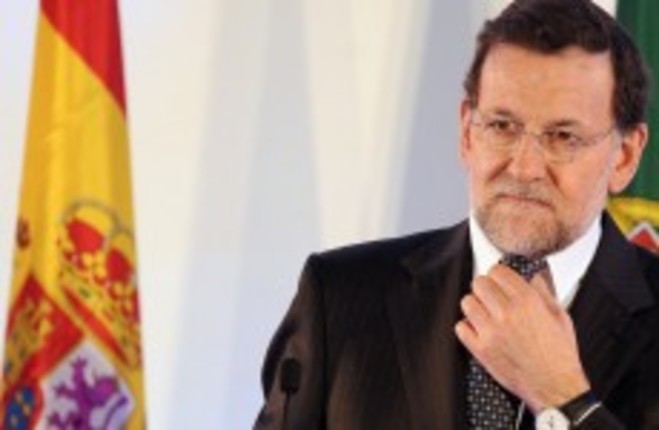
Mariano Rajoy wants to plug a €19bn gap in Bankia by giving it a government bond directly.
Image: Paulo Duarte/AP

THE COST OF BORROWING for the Spanish government has reached its highest in six months this morning, as investors dumped shares in one of the country’s major banks which has sought a €19 billion bailout.

Shares in Bankia, the country’s fourth-largest lender, opened with a 24 per cent loss in Madrid this morning before paring back some of the earlier losses to lose about 15 per cent of its value.

The large-scale sale of Bankia shares came after the bank – formed in 2010 through the merger of seven smaller, troubled lenders – said it would be seeking €19 billion in funding from a special State fund established specifically to recapitalise the financial sector.

The cost of a 10-year loan for Spain rose to 6.45 per cent on the back of the news, the highest it had been since late November before the ECB’s aggressive bond-buying programme managed to ease the oversupply of secondhand debt.

Borrowing costs were lower than 6 per cent as recently as May 10 – with the spike indicating that many investors feel the cost of recapitalising the banking sector could, as it did with Ireland, end up seeing the Spanish government priced out of the market itself.

Novel solution

It has been suggested that Spain hopes to fund Bankia in a system similar to that used by Ireland in making the last repayment on its promissory notes: by issuing a government bond directly to Bankia, which can then be presented to the ECB as collateral.

This would avoid the need for Spain to have to sell a bond on the open markets – potentially at penal interest rates – simply to fund a private institution.

This lunchtime Rajoy said the rescue of Bankia would not affect the Spanish government deficit, and called for the new European Stability Mechanism to lend directly to banks – echoing a similar call previously made by Enda Kenny.

The request for a bailout caps a year for Bankia since it was first listed on the Spanish stock exchange: shares in the bank were originally priced at €3.75, and enjoyed two weeks of growth before beginning a steady decline.

This lunchtime’s price of €1.31 means investors who bought at the IPO have lost 65 per cent of their investment, with over €2 billion of the bank’s original €3.1 billion value wiped out.

Bankia’s troubles also come after the local administration in Catalonia, the wealthiest of Spain’s autonomous governments, on Friday asked for help from the central government in meeting its obligations.

Catalonia must not only cover its deficit this year but is also due to repay €13 billion of previously outstanding bonds.

Read next:

Comments (6 Comments)

  • Has the Spanish PM said Spain will not require a bailout and they are not in talks with the ECB/EU/IMF yet?

    Reply
  • “This lunchtime Rajoy said the rescue of Bankia would not affect the Spanish government deficit, and called for the new European Stability Mechanism to lend directly to banks – echoing a similar call previously made by Enda Kenny.”

    Funny, our bailout of the banks got turned into sovereign debt, but Kenny wants to support Spain in keeping their banking debt off the Spanish sovereign debt metric.
    Believe it or not, i support Kennys move here, because if Spain are allowed to do this, then Ireland must be allowed to remove the 64 billion private bank debt from its books as well.

    Reply
  • Lets just hope they don’t have to make their bank debt sovereign, because as always we will have to piggy back other countries negotiating skills, such as the Greek interest rate cut that fg/labour shamelessly try to take credit for. Fingers crossed.

    Reply
  • Watch the spaniards sleep walk their way into the same morass that we’re in, with their greedy lying banks cheering them every step of the way!!

    Reply
  • Catalonia’s problem is that taxes collected there are administered by the Spanish governament. The result of that is that Catalonia is bailing Spain out with 22bn each year, that’s the money collected in Catalonia that goes to Madrid and never comes back. Apart from all the motorway tolls whose benefits are used to build toll free motorways in Spain, the airports in the midle of nowhere (Ciudad Real) and high-speed trains stopping in rural areas. As an independent country Catalonia would be the 4th wealthier in the Eurozone.
    Bankia is the best example of how things are done in Madrid: minimal effort, speculation, business with family and friends, long established elites that arose during Franco’s dictatorship. “Pelotazo” is the Spanish word for all that.
    To put it in sport terms look at the different values of FC Barcelona and Real Madrid or Messi and Cristiano Ronaldo.

    Reply
  • and just yesterday the justice minister said that there is no need to hold an official enquiery into the bad management at the bank and the fault lies with the previous goverment so if the other crowd is at fault why not open one up is it that the savings bank like caja madrid what was controlled by their political party and their buddys who ran it and now have salarys for life that cant be touched mmm there just short of saying the socialists ate my homework

    Reply

Add New Comment