Business ETC uses cookies. By continuing to browse this site you are agreeing to our use of cookies. Click here to find out more »
Dublin: 17 °C Wednesday 19 June, 2013

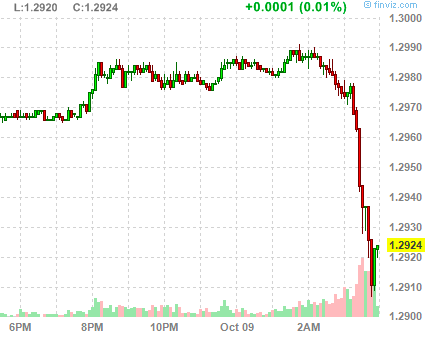
Scary Graph of the Day: euro vs dollar

Warring Greek creditors and higher Spanish yields might both play a part in this large drop.

FROM FINVIZ, here’s the euro vs. the dollar today:

euro

It’s not totally clear what’s behind the move, but a Wall Street Journal report about how Greek creditors were at “loggerheads” may be a culprit.
It could be something else. Spanish yields are also notably higher on the day.

As noted earlier, the drop in the euro is part of a broader “risk off” move.

  • Share on Facebook
  • Email this article
  •  

Published with permission from:

Business Insider
Business Insider is a business site with strong financial, media and tech focus.

Read next:

Comments (31 Comments)

  • Might be worth noting that the drop shown in this graph is 0.8 of one cent, or just over half of one percent. This is not an enormous currency move.

    Reply
  • Another slow news day no doubt, I can see a screen shot from Met Eireann coming along anytime now

    Reply
  • I’m checking XE Currency converter everyday as I’m living in Sydney and coming home early next year. The euro is at the strongest its be been for months against the Aussie dollar. Maybe that’s the Aussie dollar weakening at a quicker rate than the euro maybe!

    Reply
    • That’s actually just Australia’s growth slowing down. China isn’t buying all the Iron ore etc… Also most Australians who can afford to buy stuff have what they need and are spending wisely enough, meaning all the big chain stores are also seeing slow to no growth. Mining needs customers, but it’s still the land of opportuinity.

      Reply
    • Sean C 09/10/12 #

      Your theory would be sound Hugo except for the fact that most states earn no income, or there economies grt no benefit, from mining as its mostly confined to WA, and up until 3 months ago the miners paid no tax. The “brick & Mortar” retailers are feeling the effects of two issues beyond their control; firstly the digital economy is growing and people are shifting to buying on line. Secondly people are using more of there disposable income to draw down their home loans and spending more on overseas holidays.

      Reply
  • Just turn the graph upside down and everything looks really good for the euro.

    Reply
  • But the € doing better against the GBP……

    Reply
  • This graph is totally misleading, it’s not even moved one cent…

    Reply
  • Seriously Journal? This is disappointly tabloid from a site that I respect. Manipulation of data can make anything look scary if you try hard enough. Are you trying to suggest that somehow the euro is collapsing in value?

    For a more realistic graph try the following link:
    http://www.x-rates.com/graph/?from=EUR&to=USD&amount=1

    If you look at that graph you’ll notice that the Euro is trading higher against the Dollar than it did around a month ago and had traded within a range of €1 = $1.27 to $1.30 for around the last month.

    Reply
  • Have i logged into the daily mail?

    Reply
  • Moves like this are very common, what’s the big deal

    Reply
  • OH MY LORD! IT’S ENDTIMES! NOT A DECREASING GRAPH!!

    Reply
  • The euro is about .78 against the dollar but banks like anz will only give you .75 or .76..headin home from oz at Xmas so hope I don’t get hit too bad changing money over !

    Reply
    • The euro was weak when I came over so I kind of got screwed and when I’m going back, if it’s strong I’ll get screwed again! Plus as you say the commission rate by the banks is sickening over a few thousand dollars/euro!

      Reply
    • Currencyfair.com for changing over your AUD to EUR. You will get the interbank rate. I’ve been using it for a long time. Couldn’t recommend it more!

      Reply
  • Both the euro and dollar are toast, comparing them to each other is meaningless.

    You should compare them to something of real value like gold.

    Both currencies are being debased.

    Reply
    • The federal reserve currently has a 100 Year contract to print the US Dollar, that contract runs out in December 2012. Interesting times ahead.

      Reply
    • gold bugs …

      gold is a piece of metal, the value of which is based on someone giving you more than you paid for , at 1800 an ounce its not cheap – like buying houses in ireland thinking they can go up forever

      anyway

      when the zombies take over and the doomsday preppers have their dreams come true, you can swap gold for things that are actually useful, like food and medicine – or better still spend money on your bomb shelter now

      Reply
    • Gold can have its shocks too. If a new source of gold was discovered, it’s value would shoot right down. This has happened at least once before, when South America was discovered. More realistically now, there is probably a vast amount of gold in the rocks below the ocean floor; if we find a good way of recovering it, imagine what would happen to the gold price.

      Reply
    • A more worrying graph.Perhaps.

      http://www.brillig.com/debt_clock/faq.html

      “Economic Volatility – Since fiat currencies are loosely coupled to physical economic activity in the objective world, they tend to become increasingly de-coupled and eventually “un-tethered” over time.
      Currency Debasement – Voltaire famously wrote that “Paper money eventually returns to its intrinsic value—zero.”
      Wealth Redistribution – Arbitrarily increasing the quantity of currency in an economy distorts the distribution of money and, therefore, redistributes purchasing power, effectively stealing wealth from the majority, e.g., savers and wage workers, to serve the interests of a privileged minority.
      Concentration of Wealth – Over time, fiat currency schemes cause wealth and property to accrue to those who enjoy the extraordinary privilege of creating the currency, thus increasing the concentration of wealth in society.
      Moral Hazard – Baron Acton observed in 1887 that “Power tends to corrupt, and absolute power corrupts absolutely.”
      Corruption and Cronyism – As a consequence of moral hazard, fiat currencies tend to encourage cronyism and corruption and ultimately produce a culture of corruption.
      Confidence Failure – Since the value of fiat currencies is essentially subjective, maintaining the perception of “value” in the face of economic decline and despite rising prices can be challenging. Counterparty Risk – The “value” of fiat currencies requires trust in counterparties, but trust, like confidence, is an ephemeral, subjective mental state.”
      Cliff Kule

      “For those of us who understand what is unfolding, it is an amazing opportunity to prosper and thrive because the greatest transfer of wealth from those that hold their wealth in paper to those that don’t is firmly underway. As this is priced into markets, “volatility” shall reign supreme as the Ship of Fools tries to elude its fate, driving markets (stocks, bonds, currencies, commodities, natural resources, energy) up, down and sideways as they seek shelter from the unfolding storms and maelstroms. But there is no escape as they have failed to learn history’s lessons and are doomed to repeat them. For the prepared investor, the opportunities are immense.”
      Ty Andros

      Reply
  • I tend to check my currency app everyday to see how the Euro fairs against the Aussie Dollar…about 6 weeks ago the dollar hit an all-time high of 0.86 AUD to 1 EURO….this has now dropped to 0.78 AUD to 1Euro. The Euro seems to be holding its own!

    Reply
  • Thanks Steve is currency fair safe?I was reading about it there and it seems very good!

    Reply
  • this is bullish for Euro

    http://online.wsj.com/article/SB10000872396390444897304578046012096016352.html?mod=googlenews_wsj

    Financial data provider Bloomberg LP Tuesday said it is investigating the cause of an error which led it to switch its benchmark 10-year Spanish bond, a move that caused confusion in currency markets.

    The change to using a bond maturing in January 2024 instead of the previous January 2022 benchmark prompted a flurry of media reports that Spanish 10-year government bond yields had surged back above 6%, a rise of around 0.3 percentage points from Monday’s close.

    Bloomberg said the change was made in error and has been reversed. The company, which competes with Dow Jones Newswires as a news and data provider, said it had notified all its clients of the mistake.

    Reply

Add New Comment