Business ETC uses cookies. By continuing to browse this site you are agreeing to our use of cookies. Click here to find out more »
Dublin: 15 °C Tuesday 18 June, 2013

Nick Leeson: Look to Swedish model of dealing with toxic banks

The former trader has been visiting Sweden – and looking at how their management of a bank crisis contrasts strongly with the Irish government’s treatment of Anglo Irish Bank.

Nick Leeson

AS GOVERNMENT OFFICIALS and the banking hierarchy met in Leinster House in September 2008, they all had several things in common: a blank look, a glazed expression and each was equally bereft of ideas to solve the crisis that was facing them.

Whilst I am sure that the scope of meaningful discussion was far more superficial than many would have wanted, that wasn’t because of malicious intent. It was more to do with the fact that nobody really understood how grave the situation was. The outcome of the meeting was a bank guarantee that settled matters for a while, bought each of those individuals some time and ultimately cleared the way for the nationalisation of Anglo Irish Bank.

We will all be paying for those decisions for many years to come.

I was in Sweden this week and was reminded of how very different the outcome could have been. Sweden right now has a buoyant economy, has tremendous purchasing power and is also home to at least 1,500 Irish people. It is also a country that is no stranger to financial scandal but is also a country that has recovered better than most.

Around the same time that the heated discussions mentioned above were taking place in Dublin, there were very similar discussions taking place in Stockholm.

They had their own problems with a struggling investment bank, Carnegie. Carnegie was a revered trading house and was first started by Scotsman David Carnegie in 1803 and had around 1,100 employees. The bank had suffered a series of serious mistakes, principally related to a lack of controls, and found itself drained of funds, leading to Sweden’s financial regulator to revoke its licence.

“Sound familiar?”

The bank’s demise was caused by a 1 billion kronor (€119 million) write-down against a loan to a borrower who apparently posted collateral that could not be valued. Sound familiar?

Even in its death throes, the bank refused to provide details of the loan which had been on its books since 2004. The Financial Supervisory Authority took their decision because the bank had been taking “exceptional risks for a long time by lending large amounts to one individual client” and that, as far as they were concerned, violated Swedish banking law. The future looked bleak until Carnegie became the first state nationalisation of a bank since a financial crisis of the early 1990s. The similarities between that situation and ours with Anglo are clear.

The Swedish national debt office took control of the bank after it offered up loans of around €501 million to the firm, replacing loans that the central bank had previously provided to keep the bank liquid. Carnegie’s shares were posted as collateral for the debt office loan. In a statement, the debt office stated that the decision had been taken “in order to protect the financial stability and to preserve the value of the collateral”.

Sweden’s centre-right government had taken power in 2006 aiming to sell off large chunks of state assets; the financial turmoil meant that they could not follow their intended manifesto. The Prime Minister told journalists: “We don’t believe that the state should own banks and therefore it should be returned to the market as soon as possible.” The Government had already privatised Absolut Vodka maker Vin and Sprit and sold a number of other holdings but retained a legacy holding in the banking group Nordea from the previous banking crisis: they didn’t want any more like it.

All debt was written off, all shareholders were completely wiped out regardless of their class of equity. A lot of people were upset but there was only one way to resolve the issues. Carnegie was eventually cleaned up, sold off and is now once more again in private hands and no longer a burden to the taxpayer.

Compare and contrast this with what has and will continue to happen with Anglo Irish; there is no comparison!

“They understood the risks”

Ireland limps along trying to pay off loans which are assumed to pay the bondholders. Like investors in Carnegie, they all knew the risks that they were assuming. As bondholders, rather than normal shareholders, the likelihood is that they understood the risks far more clearly.

Some may say that Sweden had more experience, having weathered a previous crisis in the 1990s but I believe even more so that the politicians had the power of their convictions. It’s difficult to say the same in Ireland where the government have been bullied and cajoled along by those that really pull the strings in Europe. While the Irish voted Yes in the EU treaty referendum this year, Sweden continues to be stand strong against those same people. Just this week Swedish Finance Minister Anders Borg said his government will never agree to let taxpayers in the largest Nordic economy bail out “ill-managed” banks elsewhere in Europe.

In his latest attack against Europe’s proposed banking union, Borg called the basic structure proposed for a common European banking framework “unreasonable,” arguing that Sweden won’t accept a model that gives euro members more clout than European Union states outside the currency bloc. The 1,500 Irish in Sweden are best staying put.

Read other columns by Nick Leeson>

  • Share on Facebook
  • Email this article
  •  

Read next:

Comments (27 Comments)

  • The public coffers are empty through a combination of bank debt and overspending. The private sector is crippled with excessive bank interest rates. The economy is stagnant because of this, yet the government is not getting to grips with it. Neither sector can grow. Enough of this nonsense it’s clearly not working, regular businesses in Ireland are unable to grow and develop at these rates.

    Reply
  • The country is broke…and we are being forced through cuts and inhuman demands to cover illegal debts of the richest banks in the world who knew that they were selling junk.Enough is enough..no more
    The man who changed Iceland – the message for Greece. http://www.youtube.com/watch?v=YH0_JQW–gc

    Reply
  • Interesting article but surely the fundamental difference between Sweden and Ireland is the euro. Ireland had no choice but to guarantee the unsecured and secured bond holders due the pressure put on us by our EU partners. I think every Irish person would agree that the bond holders should have been burnt and now it emerges that we’re about to stiffed yet again following the three finance ministers recent comments. Ireland is rapidly bending impoverished and notwithstanding our own culpability in bringing this mess upon ourselves I wonder how it will all end? Ireland impoverished and broke but with all our debts repaid to German, French and British banks.

    Reply
    • The Euro??? how does that make any sense??? the banks debts were the banks debts – Euro or no Euro. “The pressure” – what nonsense, you think pressure wasn’t put on Sweden and Iceland to pay their bank debts?? the only difference is they chose their people over big business. The Euro has feck all to do with it.
      The bank guarantee should NEVER have been put in place.

      Reply
    • Fair point, but I would dispute that the bullying came from within Europe – it also came from within Ireland itself and from the US, who apparently have resolutely refused to permit a negotiated settlement with unsecured bondholders – possibly to protect the interests of banks already suffering losses because of other bad investments. Our timing was a large part of the problem, and lets be honest, that FF/PeeDee government held enough idiots to fill an institution several times over. There was little chance that a powerful settlement could have been made at the time. The Quinn situation really finished much of that off: politically, it would have been suicide to simply let the Quinn group collapse alongside Anglo and the other bad institutions. Had we done that, as much as it would pleasure the “burn the bondholder” bleating sheep, we’d now be looking at an economy with a monopolized banking system consisting of just Bank of Ireland and possibly a couple of small foreign players. If Quinn and the more rotten of the rotten banks had actually collapsed, I’d gauge that unemployment would be about 250,000 higher than it is now.

      What Lenihan really did at the time was inflict slow painful death rather than permit an imminent collapse. This will cause pain for a longer time, but it probably protected the jobs and interests of up to 250,000 people – which to be honest, can’t be ignored.

      But the real problem now is the slow infection of the rest of Europe as a result of Spanish disease, as well as potentially Italy and France.

      Reply
    • How can you say it protected the jobs of 250,000 people when 40000 people are leaving every year to go find work elsewhere ! The Icelandic economy is in steady growth since 2009 when it burned it bank holders. It might not be looked on as a good place to invest in at the moment but it has the right model to get growth happening again. Sweden arent doing to bad either after doing the same. We are giving 1 billion away today, thats 17 billion so far this year & another 18 billion next year to un secured bankers. Thats a lot of billions that could recover the economy to growth. We need to grow a pair & stop giving money away and borrowing it back at interest

      Reply
  • 1000 million euro. that’s how much money is being given to bondholders today. 1,000,000,000.

    Reply
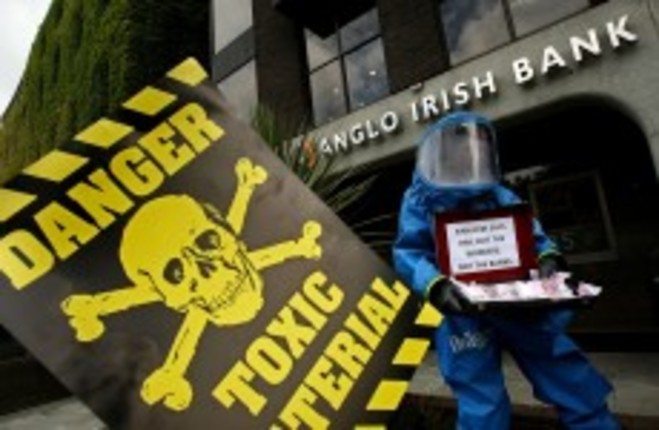
  • I read the headline “Look to Swedish model…” and immediately entered the article only to be dissapointed by a picture of some dude in a bio-hazard suit #NotOneForTheWankBank.

    Reply
  • “It’s difficult to say the same in Ireland where the government have been bullied and cajoled along by those that really pull the strings in Europe”

    This article is a decent swipe but fails to land a heavy blow because you fail to mention who it is that really pull the strings in Europe and why they are so powerful and what we can do to take power back from them.

    Without doing that you leave the lay reader hopeless and powerless.

    Reply
  • As usual Mick Leeson gives a concise and feasible solution to a finance issue.He has come a long way from his ‘dark days’ and I for one have a lot of respect for the man.Good on you Nick…keep fighting the fight!!

    Reply
  • 1500 Irish people in Sweden! Must not be from Galway or Kilkenny. There were only 9 paddies in O’Connells in Gamla Stan yesterday for the match.

    The analysis is overly simplistic though. The housing market has been tightly regulated here since their property crash in the nineties so the economy was in very good shape when the world economy went into decline. There are several other key differences in relation to taxation and public expenditure that make comparing difficult. I agree with the key point however. It has a government that thinks of all the people as equal – for good or for bad.

    Reply
  • Boycott and burn!!! Coming soon !

    Reply
  • Good article but some of the usual benign assumptions of the master banking system such as:
    “The bank had suffered a series of serious mistakes, principally related to a lack of controls, and found itself drained of funds…”

    - These were NOT mistakes. These are 100% intentionally orchestrated manipulations of banks to extract money from unsuspecting citizens and nations. If you audited the bank mentioned, you would find to whom the funds were drained to….

    Reply
  • Here’s my solution to “toxic” banks:

    - Collapse them (and lose any deposits) and DO NOT fill them up again with the debts of taxpayers.
    - Prosecute the fraudulent manipulators who own them.
    - Nationalise the money system and control the money supply.
    - Eliminate the Ponzi based Fractional Reserve Banking system.

    I think the advise and opinions from conventional economists and money people is a complete joke at this stage.

    Reply
  • “they all had several things in common: a blank look, a glazed expression and each was equally bereft of ideas to solve the crisis that was facing them.” Reminiscent of the staff, directors and shareholders of Barings bank and indeed of one Nick Leeson when the bets with other peoples’ money to cover previous bets with other other peoples’ money lost!

    Reply
    • There it is! Knew there’d be one.

      Reply
    • Doesn’t make him wrong here.

      Reply
    • I believe mr. Leeson went to jail and served his time for that so there is really no need to bring it up anymore . Think of a hacker giving advice about digital banking security or an ex safe cracker providing security advice , which is actually a tad unfair because bearings did not collapse due to wanton criminality but more because of a trader trying to cover the ass of an employee by using some loopholes in regulation that probably don’t exist anymore. The sort of trading and investment skullduggery perpetrated by some of our most upstanding citizens in the past few years far outweighs anything mr. Leeson ever did.

      Reply
    • Guys, might my comment have been related to the irony contained in the ham-fisted pseudo journalistic attempt at ‘scene setting’?

      Reply
    • Well… no, I don’t think so Blathín. I call it Leeson’s law: it states that anything he writes on thejournal.ie, on any subject, will soon be followed by a comment reminding us that he collapsed Barings Bank back in ’95.

      Reply
    • Mark Downes, blind hero worship leaves sufferers unable to intelligently process information before them. We could amend your Leeson’s law to state: the opening lines of any article must contain leading statements designed to “prime/influence” readers rather than inform them.

      Nick Leeson was not in Leinster House in September 2008 to observe “a blank look, a glazed expression” on anybody’s face. Nor was he part of the Merrill-Lynch team employed to advise the minister of Finance and government officials et al. Accordingly he was in no position to observe the Merrill-Lynch team et al being “bereft of ideas to solve the crisis that was facing them”.

      So why did Leeson choose to open this article with a figment of his imagination? If he is prone to using imaginary figments, then the quality of his works/writings are called into question.

      Wake up Downs and smell the coffee.

      Reply
    • Come on Blathín, read your initial comment. You only developed a problem with Nick’s content when you were called out for your initial intention: to remind us of his history at Barings.

      Reply
    • Yawn

      Reply
    • unlucky Blathín! you’ve learned a valuable “Leeson” there.

      Reply
    • Mark Downes, proving the first sentence of my last comment is no defence. If irony is lost on you, so too is the power to intrpret what is not explicit but implied. You missed it so completely that I had to spell it out for you and that reveals more about yourself than I think you would have liked to reveal.

      Reply

Add New Comment