Business ETC uses cookies. By continuing to browse this site you are agreeing to our use of cookies. Click here to find out more »
Dublin: 8 °C Thursday 23 May, 2013

Residential property prices record first monthly increase for five years

The CSO’s Residential Property Price Index shows prices increasing – but they’re still at only half of their peak value.

While some regions have seen isolated increases in prices, the latest CSO index marks the first time that property prices have been up on an overall, national basis.
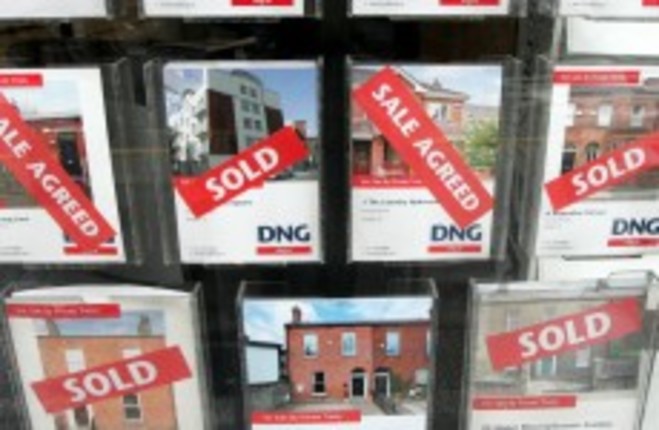
Image: Sam Boal/Photocall Ireland

THE OFFICIAL RECORD of domestic property prices has recorded its first increase in almost five years.

The Residential Property Price Index, compiled each month by the Central Statistics Office, says prices in May were 0.2 per cent higher than they had been in April – the first time since August 2008 that prices have increased month-on-month.

On a annual basis, however, prices are still down by 15.3 per cent compared to where they stood 12 months ago – and are down by exactly half from their peak prices of early 2007.

House prices nationally were up by 0.1 per cent, dragged upward by the performance of houses in Dublin where prices were up by 0.5 per cent compared to April.

The price of apartments in the capital hit the overall average, however, with prices down by 1.6 per cent in one month – reversing a previous short-term trend where prices had risen by over 2 per cent in both March and April.

Apartments outside Dublin also had a torrid month, falling by 2.0 per cent, undoing the 2.1 per cent gain of April.

Homes outside Dublin increased by 0.1 per cent, but are still down by 2.4 per cent in the last quarter and by 14.2 per cent in the last year.

Overall, residential properties nationally are now worth 50 per cent of their peak values, while houses in Dublin remain 55 per cent off their peak  and apartments in the capital are off by 61 per cent.

Outside Dublin, properties are down by 47 per cent, while apartments – just like those in Dublin – are down by 61 per cent from their peak values of early 2007.

The CSO compiles the data based on mortgage drawdowns registered with Irish lenders, meaning the prices are calculated on the basis of agreed sale prices and not advertised asking prices.

The index is also designed to reflect the fluctuations in the type of properties sold at various times of the year.

Read: Cash buyer says NAMA taking too long to release properties

Read next:

Comments (34 Comments)

  • Reg 25/06/12 #

    Can’t wait to see the Indo’s spin on house prices going up by 0.1%!

    Reply
    • .5% but don’t let that get in the way of the Sindo’s spin. No housing supply purposely being held back by Nama will is putting an artificial spin on tiny increase, property database out in september should finally put an end to the disgrace and filth and lies which is the Irish property sham!

      Reply
    • Reg 25/06/12 #

      0.5% for houses in Dublin. 0.1% for residential property outside Dublin.

      Reply
  • complete B*****, Fanciful spin as per usual and it’s not very difficult to see prices are still falling. Took a peak at three property websites yesterday and discovered two properties I know well and all of whom have sold in the past 12 months, hey presto, the said properties are still listed and in one case 250k more than the property sold for. Its a joke, these sites are retaining listings just to fill pages and certainly not reflecting the truth which is properties are not selling, if they are, at greatly reduced prices.

    Reply
  • Just bought a house…delighted. Feel I paid what’s its worth and it very affordable…40% cheaper than my previous rent..same standard of living..5 minutes walk from my old rental accommodation. I think the most important thing now is that when a person buys a house..they buy it to make it HOME…not an investment. Once that’s your reason for buying then BUY. Don’t listen to people saying they are still going to fall in price…go with your gut..and take a leap of faith.

    Reply
  • One swallow does not make a Spring, but it would be good to see the market stabilize.

    Reply
    • More propaganda trying to save a tanking market as it heads into the jumbo property tax arena.

      It wouldn’t be to coincide with the genuine sold price database, would it?

      Three bedroom houses in Rathfarmam down from €595,000 to €215,000 paints a more honest picture.
      http://www.irishtimes.com/newspaper/property/2012/0607/1224317432700.html

      Reply
    • Harry, I am not a homeowner. I was some years ago, but have been renting since.
      There are many renters who would love to see the property price decline a lot more. However, if you take a high level view of it, the property market collapse is part of the economies problems.
      If it stabilises, then people will have confidence to get back into the market, and money will start to circulate again. As long as the property spiral continues, there will be a major lack of confidence and very few homes will sell.
      You are 100% right, the advertised property prices far exceed the actual selling prices. The Government still hasn’t done anything on the National Database yet, even though it would hugely help the market regain stability.
      But we really do need the market to stabilise, as until this happens, this will be one of the key indicators that will continue to ensure our economy remains in the doldrums.

      Reply
    • Reg 25/06/12 #

      Cal, I think the sales database has been pushed back until September from the original June launch date. They need to get their fingers out a get this up and running as soon as possible.

      I wonder if purchasers and banks are factoring in the future property tax into their decisions?

      Reply
    • Spot on Reg.
      Pushed back just like the ”new” insolvency legislation.

      The truth is that we will have to wait for the prices of property to fall to the point where they can be bought with real money, not reckless false cash, dished out by insolvent banks, on commissions.

      Reply
    • God help the people who think they are getting a bargain these days.

      You can’t even value Irish property based on good old rental income anymore.
      When you try to, Joan Burton and the IMF just gets the scissors out and everything goes pear shaped.

      Rent in Ireland, and if you want to buy, buy in a regulated market, where regulations are enforced.

      Reply
    • Bricks and mortar are again becoming relatively safer than other asset classes in spite of the recent collapse. Tom Newnewman

      Reply
    • If prices are stabilising (and I am unconvinced) we need to make sure that they do not rise by more than the rate of inflation, or we are back into another crazy bubble.
      Suggest that lands being re-zoned should not sell for more than agricultural or industrial use would value them. Also proper regulation of builders, developers, and enforcement of building regulations.

      Reply
    • There are a lot of wise people out there willing to take a punt on the Irish property market
      Its strange though, none of them want to use their own money to take that punt.

      Reply
    • It’s o.k. though I hear NAMA is giving out ”negative equity proof” loans to buy up their rubbish.

      Any takers??

      Reply
  • This country is a joke!

    Reply
  • Prices still need to drastically reduced so that people can buy a house and live comfortably and not be tied to the banks for the rest of their life. nMore hype from the government ant the CSO.

    Reply
    • Given that the word mortgage is essentially an anglicisation of the French “death pledge” (mort gage), I think the banks will do everything in their power to ensure that people are tied to them and their fractional reserve funny money for the rest of their lives.

      Reply
  • When people decide to put an offer on a house which they believe the property is worth and can actually afford not using other variables such as rental income, what it will be worth in X amount of years etc then the market will find it’s true level until then it’s just too unstable… Unfortunately that will never happen in property obsessed Ireland… I can just sense people are waiting and waiting until the they believe is the ‘opportune’ time and then the madness will start all over again…

    Reply
  • 0.2% increase?
    That’s great.
    I wonder how much Priory Hall went up by??

    Reply
  • Lets do the maths.

    €20,000(= decent post recession wage)
    Multiplied by 3 (= realistic income to loan multiple)
    Equals €60,000 (= 75% of the property’s purchase price)
    Plus homebuyer’s €20,000 deposit from ”savings”
    Equals €80,000 purchase price.
    Equals bringing us somewhere back to the reality of the early/mid nineties,well before the days of 100% interest only mortgages, on 6-7+ gross incomes (including overtime), rent a room, gifted deposit scams etc,etc, etc.

    Not to mention Minus property taxes, maintenance, service charges, water charges, depreciation etc etc etc.

    Reply
    • P Wurple 25/06/12 #

      Flawed.nnFirstly, the current average industrial wage is 36k. I think it’s unlikely every working person in the country would take a 50% pay cut.nnSecondly, that is not how prices are determined now, or ever have been, for anything, in the history of commerce. It is just supply and demand as usual.

      Reply
  • We have definitely turned a corner, this time. Definitely :-/

    Reply
  • DVS VIC 25/06/12 #

    When house prices fall to a level when someone on the average wage can afford the average house through issue of a mortgage, then they will be at an equilibrium. We are not there yet in my opinion, how much of a salary does the average house price imply?

    Reply
  • It’s amazing to see moral hazard raising its ugly head again. The low corporation tax has helped push a bubble on house prices. This has encouraged moral hazard, loss of competitiveness and higher inflation. The Irish elected a Fine Gael government that gave tax breaks. Ireland gives tax benefits to companies. Because Ireland thought, it would be a big business. In the end, the people will be paying out €1.1bn this week to Bondholders, than a small island economy could stomach. That was selfish thinking and now they have to pay the price.

    Reply
    • mr x 26/06/12 #

      tim let me spell this out for you in the simplest possible terms in the faint hope that you might be actually able to understand me.
      There is absolutely no link whatsoever between corporation tax and residential property prices, how you even made the link between the two astounds me.

      Reply
    • mr x,

      Jack you’re starting to polemically froth at mouth! Take my advice, go back to wherever it is you consider your little refuge; have some warm milk and toast, and maybe, just maybe, you can avoid a debilitating case of the vapors.

      Reply
    • mr x 27/06/12 #

      tim i think you might want to google “moral hazard” and find out what it actually means, (hint: its an economic term).
      Although you being a shinner I should probably make allowances for your lack of economic knowledge it seems to be a endemic in your party.

      Reply
  • We need to increase corporation tax and become more competitive by ethical ways – not by competing on taxes.

    Having a low corporation tax only leads to moral hazard, loss of competitiveness and higher inflation. We are seeing these now.

    Reply
    • mr x 26/06/12 #

      tim you have about as much knowledge of economics and taxation as my dog.
      everything you said in both your posts is absolute rubbish and makes no sense.
      try reading up on economics a bit rather than pulling absolute nonsense out of your backside

      Reply
    • @ mr x

      Having a low corporation tax is selfish thinking because in your world, it’s all about “me me me”. It wouldn’t surprise me if we are forced to increase our corporation tax under our second bailout. Rich billionaire companies can afford to pay their fair share.

      Reply
    • mr x 27/06/12 #

      ok then humour me, explain to me exactly how low corporation tax causes a residential property bubble? or do you only converse in platitudes and nonsensical assortments of hackneyed phrases. Its blindly obvious you actually have no substance to your comments or you would have put forward a theory as to how they are related.

      Reply
  • People have returned to their profligate spending habits again. That’s the side effect of having a low corporation tax – it creates a bubble.

    Reply
    • Reg 25/06/12 #

      Absolutely nothing to do with low corporation taxes, many businesses are struggling to make any profits and will be paying little or no corporation tax anyway!

      Reply

Add New Comment