Business ETC uses cookies. By continuing to browse this site you are agreeing to our use of cookies. Click here to find out more »
Dublin: 10 °C Sunday 19 May, 2013

Noonan rejects Tobin tax over fear of jobs losses

The Finance Minister said Ireland would not adopt the tax unless Britain also did – over fears Irish jobs could be lost to London.

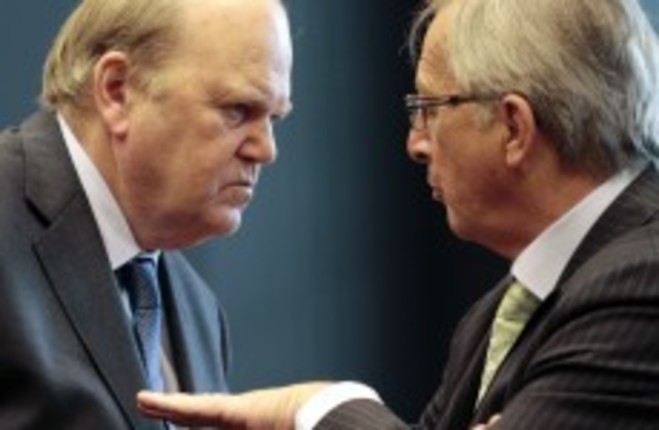
Michael Noonan talks with Luxembourg's Prime Minister and President of the Eurogroup Jean-Claude Juncker
Image: Yves Logghe/AP/Press Association Images

MINISTER FOR FINANCE Michael Noonan has rejected an EU financial tax plan over fears that it will lead to the loss of jobs to Britain.

Earlier this year, Noonan said any financial transaction tax should be rolled out on a EU-wide basis, as Ireland would otherwise risk losing financial business to Britain – which has also rejected the proposal.

Following the meeting in Luxembourg, Noonan said 33,000 Irish people worked in financial services – and that if the country accepted a financial transaction tax while Britain did not there would be a transfer of business and jobs to London.

Eleven member states – led by Germany, France, Italy and Spain - have opted into the ‘Tobin tax’, which will see the introduction of a common tax on financial transactions with the aim of encouraging responsible trading and making the markets pay for decades of excess.

“This is a small step for 11 countries but a giant leap for Europe,” Austrian Deputy Finance Minister Andreas Schieder said. “The way is now clear for a just contribution from the banking and financial sector for financing the burdens of the crisis.”

The concept of such levies was first introduced in the 1970s by US Nobel laureate James Tobin, who advocated taxes on transactions to curb market volatility.

The adoption of the tax by so many member states has raised speculation that it could be used to create a common consolidated corporate tax base (CCCTB), which would establish a uniform tax base across EU countries and in turn potentially threaten the benefits of Ireland’s low corporate tax rate.

However, Noonan dismissed such concerns – saying that the CCCTB is not a transaction tax but a corporation tax.


Uploaded by 

Column: The financial transaction tax is a must for Ireland’s future>

Read next:

Comments (33 Comments)

  • Loving Noonans poker face.

    Reply
  • Noonan is only repeating the industry lobby line, who are trying to protect their profit margins.

    The tax is specifically structured so that all firms in world who deal with EU market will pay the tax to the relevant EU member state, so no way to avoid, so no sense in any firms relocating anywhere.

    Noonan is throwing away millions in revenue to other EU tax authorities, as Irish firms will still have to pay. Just now not to Ireland.

    See Ann Cahill in todays Examiner.

    Reply
    • Thanks for mentioning Ann Cahill’s article Aidan.

      “The Government was criticised by MEP Nessa Childers, who under Freedom of Information found the Government’s only report on the issue was prepared by the hedge fund lobbying body, AIMA. ”

      Only in Ireland…..

      Reply
  • Well everyone has to be right at some point, and here Mr Noonan’s advisors were right on the money.

    They should probably consider also that Boris is talking about lowering the highest rate of income tax to 40% to further incentivise high earners in the financial and banking industries across Europe to relocate to London.

    Reply
  • @kerry , well it’s a little complicated but no he’s not basing it on that , he commissioned a report from Ireland’s ESRI specifically to assess the impact of a transaction tax earlier this year , they highlighted 3 risks the main one being that something like 30000 jobs in financial services are here and with London not signing up then there could be risk , then the EU changed the way the tax would be implemented so some of the risks in the report were addressed but not all , Ireland agrees in principle of a transaction tax but wanted it global , the g20 couldn’t agree , so Ireland wanted all 27 EU countries to sign up but they don’t agree , so now 11 countries are going anyway but UK vehemently opposes , so Ireland is not signing up yet while this is the case . There’s no one saying all the jobs are at risk but as has been said Noonan is being cautious as we are in a bad place and the timing of risking further job losses to a sector that’s 10% of our GDP is bad.

    Reply
  • He is right.

    Reply
  • This is an opportunity missed; the “wild west ifsc” needs to contribute to fix the mess it created.

    It would have had zero impact on jobs but raised easy money from speculators.

    Shame.

    Reply
    • Scarr 10/10/12 #

      @chris – I have an intense dislike for this gov but noonan is right not to implement this until London does first, it’s easy to sit back and say it would have little or no impact on jobs when, really, you don’t have to make that call, and all this in an economy where it would be kind to describe it as on life support with most of the decrease in thd live register owed to exporting people. Noonan, for once it seems, is correct not to implement this yet.

      Reply
    • I would have thought that this countrys lower corporation tax would have offset this new transaction tax. Me thinks Noonan is creating this propaganda so as to protect his powerful masters.

      Reply
  • UK won’t introduce this as just as Dublin is competing with London. London is competing with Singapore, etc.

    Reply
  • This tax should be introduced, allmost all of the financial services job in dublin are in admin. The tax would have little effect in irish jobs while reducing the volatility in the markets. the only people to gain from not introducing this tax are the banks and hedge funds…. here we go again, gov supporting big business interests

    Reply
    • How can the tax have little effect on Irish jobs and simultaneously reduce volatility?

      Noonan was 100% on the money not to introduce this until London does.

      Reply
    • One of the causes of increased volatility in the markets in recent years has been the introduction of high frequency trading by hedge funds and traders at investment banks, remember the flash crash of May 2010. This type of trading has no place in the financial markets, yes there should be liquidity, but this is overkill. Any jobs lost in Ireland would mostly come from companies using this type of strategy, so the impact would be minimal if any. This is just the government putting big business interests before the people!

      Reply
    • I don’t disagree with the theory behind introducing the tax David, it just has to be done on a fully multilateral basis for the theory to have any impact.

      Reply
    • You’re right Bob, we need global financial reform and regulation, with heavy penalties for white-collar scams like the sub-prime bundled-slurry bubble.
      Given the damage these mafiosi did I’d throw away the key. Deterence has its place.

      Reply
  • We don’t need the services of the parasitical financial kind anyway. Let them f off if they choose to.

    Reply
  • Financial controls in Ireland are within the governments remit and Noonan could have imposed this tax which would signal more solidarity with those who financed debt to Ireland.A missed opportunity for this government.

    Reply
  • Financial services companies are always looking for the cheapest way to do trades.

    I worked for a financial company that did a huge amount of trades in Ireland as opposed to their home market because it was cheaper to do them in Ireland. I don’t know if they are still doing that but I can guarantee that if it became dearer to do those trades in Ireland they probably would have no hesitation in moving that operation to another location. There is a risk involved in doing this.

    Unless this is a universal tax across the EU we shouldn’t move forward with it. If you look at the video that accompanied this you’ll see that the last country to do this in a unilateral way (Sweden) suffered as trades moved offshore, especially to London. The same thing would happen today.

    Reply
    • And you do not think that joining France, Germany etc in imposing the tax would be a step towards a universal tax across the EU?
      High frequency trading serves no purpose.

      Reply
    • agree Jim , although they EU made some specific adjustments to how the tax will be implemented to try avoid the risk of relocation- they are looking at charging a transaction on trades if the share originates in the EU….the transaction tax has to be paid on the european company transaction regardless of where you locate the dealer—the theory being the euro business being traded is unlikely to move away from the euro market even if the traders want to…but Im not convinced that the risk posed especially by London not signing up has really been fully addressed and I think Noonan is right to keep powder dry on this occasion and see how it pans out – there is little doubt that if this launches successfully and everyone does sign up its the first of a very obvious road to tax harmonisation for the entire EU and that really will be somewhat of a game changer for Ireland

      Reply
  • When are these guys going to pay for the mess they created, also we mustn’t forget who allowed them do it!

    Reply
  • he might be right,Noonan,,but he ,and ireland, will do as thay are told ,,,end of!!

    Reply
  • All talk. It will be implemented whether we like it or not. Noonan is just talking crap to win a little support from us. He is in favour of it- the puppet that he is.

    Reply
    • Scarr 10/10/12 #

      @jason – just because it was not implemented yet does not mean noonan is against the tax in principal – I would like to see this tax come in eventually, the time is not right at the moment is all. Again, it’s easy for us to sit in our own jobs and be all ‘shoulda woulda’, but until you are sitting with a document in front of you that you have to sign that potentially puts more jobs at risk in an already fragile economy then you’re just a hurler on the ditch – I don’t mean that in a disparaging way.

      Reply
    • Scarr The question is what is Noonan basing his decision on? The report drawn up by AIMA?

      Reply
    • Scarr 10/10/12 #

      @kerry – im not sure what he based his decision on, and if I get a chance later I’ll read Ann Cahills article, all I can say for now is that if I were noonan, I would think long and hard before implementing any penalty that would increase Londons attractiveness over Dublin for financial institutions. I don’t like the decision, but I can see the logic.

      Reply

Add New Comment