Business ETC uses cookies. By continuing to browse this site you are agreeing to our use of cookies. Click here to find out more »
Dublin: 11 °C Sunday 19 May, 2013

MEPs clear way for ‘opt out’ on transaction tax feared by Noonan

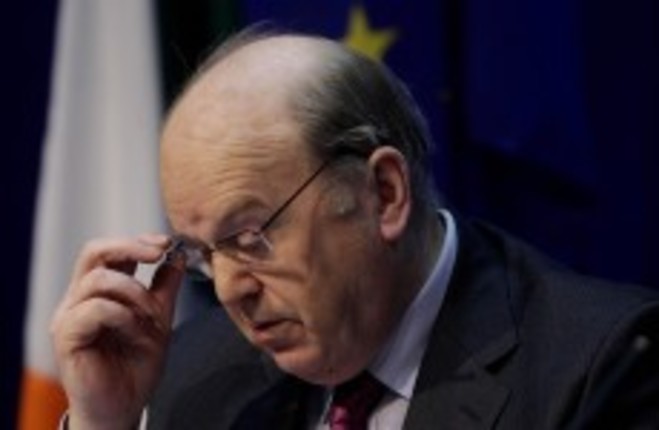
A European Parliament committee allows countries to opt out of a transactions tax – a proposal Michael Noonan openly opposes.

Michael Noonan had openly opposed a system where the financial transaction tax did not apply to all member states.
Image: Niall Carson/PA Wire

MEMBERS OF the European Parliament have today voted in favour of a resolution which would see a financial transactions tax rolled out in some, but not all, EU member states – a move likely to be opposed by the Irish government.

The parliament’s committee on economic and monetary affairs adopted a resolution approving the European Commission’s proposal to roll out a financial transactions tax throughout the EU.

In the absence of full agreement between all 27 member states, however, the committee included an amendment which allowed the process to be “accelerated”.

“Certain Member States could adopt the provisions of this Directive by way of enhanced cooperation,” the MEPs’ resolution said – essentially outlining a system, similar to that being used for the Fiscal Compact, where individual states can group together to apply the tax.

This goes directly against the wishes of Michael Noonan, who earlier this year said Ireland risked losing financial business to the UK if the tax was not rolled out on an EU-wide basis.

“If, as some countries have proposed, the tax was to be brought in under enhanced co-operation arrangements, we would fear we could lose business to London, since the UK is strongly opposed to this initiative,” Noonan said in February.

The opt-out clause was inserted following pressure from Cyprus and Sweden, who had complained that plans to roll out an EU-wide tax were in breach of the principles of subsidiarity. The UK and Germany have both expressed opposition to the tax too.

The text adopted by MEPs – by 30 votes to 11 – adds details of an “issuance principle” which would see financial institutions outside of the taxed area still pay the tax, provided that the transactions related to assets within the taxed area.

So, for example, shares in an Irish company being traded between parties in the US and Australia, for example, would be liable for the tax.

Following pressure from MEPs from across Europe’s geographical and political divides, pension funds will be exempted from the plans.

The resolution will now go forward to the plenary session of the parliament where it will voted upon by the full chamber of 754 MEPs.

The European Parliament estimates that the tax – sometimes called the Tobin Tax, after economist James Tobin who first suggested it – could raise €57 billion every year.

Figures produced by the European Commission last month suggested a tax could ultimately halve the amount Ireland contributes to the EU budget – to €534 million – by 2020.

Read next:

Comments (24 Comments)

  • As somebody posted on The Journal the other day
    http://img137.imageshack.us/img137/9826/peckingorder.jpg
    I think the picture explains everything.

    Reply
  • It makes you feel so weak and unimportant. With some of the stuff the EU imposes on us the government put on a bright smile and say – Look, it’s actually brilliant, you’ll see, you don’t understand it but we do, don’t worry.
    But when the Minister for Finance openly opposes something and he’s told – shhhhhh bold boy, sit down, too late, we already voted, it’s just……….awful.

    Reply
  • Dave 25/04/12 #

    Agree with a tranasaction tax – but only if applied everywhere.

    Reply
  • this tiny tax (0.01%) is the very least the financial sector can do after the damage it has wrecked. it won’t affect normal investments but only speculation. people should read up before judging and stop listening to the finance lobbys

    Reply
    • I don’t think the main issue is the direct effect of the tax. This tax could have a knock on effect in that companies who currently operate in the global financial sector from bases in Ireland may choose to migrate to countries where the tax does not apply. This is a huge issue.

      Reply
  • Michael Noonan: The Banker’s Friend.

    Reply
  • Well, there goes my job.

    Reply
  • The proposed Financial Transactions Tax is immensely important for us in Ireland as well as people across Europe. The tax does three things: firstly it would liberate up to €200 billion annually across Europe if applied at the level proposed by the PES (Party of European Socialists, including the 3 Labour MEPs) of 0.05% of the value of trades, and secondly it would act to dampen the wilder swings in speculative trading that arise from both algorithmic, computer trading and the animal herd behaviour of traders. Thirdly, it would finally make those who brought the whirlwind of economic, debt and fiscal crises down upon us pay some of the costs of their criminal recklessness.

    Rather than worry about the possibility that some activity might migrate from the IFSC, a wildly overplayed threat, by the way, the Irish government should get strongly behind this proposal. The European Commission has estimated that the Financial Transactions Tax would raise some €450 million in Ireland alone that could be used to support public services and relieve some of the tax pressure faced by Ireland’s coping classes.

    Reply
    • Do you actually have any idea how much the IFSC generates for our economy? 450 million is an insulting figure to be comforting people with.

      Reply
    • Poor old Charlie would be sad to see his IFSC fade away. Don’t think those employed there directly or indirectly would be happy either.

      Reply
    • The Financial transaction tax will ultimately be passed on to consumers by those financial services companies that don’t migrate. This will have an inflationary effect driving up the cost of all goods and most adversely effecting the less well off and those on fixed incomes.
      This tax (in common with all taxation) will impair economic activity in Europe.
      Only the economically illiterate could believe that it is possible to tax a nation/region out of recession.
      Does it make sense to impose taxes on a section of the economy with one hand while providing emergency liquidity with the other?
      Ireland is unlikely to impose this now that the Euro parliament has offered an opt out.

      Reply
    • Spit on analysis Sean.

      Reply
    • Spot on analysis Sean

      Reply
    • censored 25/04/12 #

      So we’re “economically illiterate” because we want a way for Bankers to pay for some small part of the cost of recurrent bank crises? Yeah right.

      Reply
    • Or apply reverse psychology. The facts in the dail only think of themselves. If they are against…. its good for the normal working people.

      Reply
  • I’m sure Sinn Feins next leaflet will suggest that if we vote No, the tax wont apply to Ireland!

    Reply
  • There was me thinking we are at the heart of Europe and no one listened to Noonan? I’m shocked so I am.

    Reply
  • Unreal this country is going to push the big firms away . I think a war is coming soon as this is history then start again

    Reply
  • A transaction tax is a good idea. We can use it to build up an insurance fund against the next banker driven crisis.

    Reply
  • I strongly Agree with this tax. Recent years have seen most peoples earnings and businesses decline while those in the global casino get lavish bonuses. Financial products such as derivatives and other vaguely phrased methods extract wealth with every turn of the market. The more turmoil and uncertainty they and their spin doctors create the greater the bonus. Our banks have turned into predatory cannibals, structured and cross linked to create maximum bonuses for the players. While those of us whose money they play with look on as dis empowered spectators. Mothers, nurses, teachers, engineers, farmers & entrepreneurs should earn more than bankers in a sane society as they create nothing. Banking should be regulated as other utilities are, such as power companies etc in that they provide liquidity. Period.

    Reply
    • I agree, it was the gradual dilution of the controls put on banks in the US by Roosevelt that led to the madness that culminated in the present crisis. From Reagan onwards successive administrations, both Republican and Democratic, gradually eased controls imposed on banks until there were almost none left leading to casino like speculation on more and more complex financial products until nobody really knew what the hell they invested in in the first place until it blew up in their faces.

      Reply
    • The US economy into a deep recession in 1920. The Federal government responded by cutting spending from $18.4 billion in 1920 to $6.5 billion in 1921 and €3.3 billion in 1922. The Fed respoded by increasing interest rates. So ended the forgotten depression.
      http://www.thefreemanonline.org/features/the-depression-youve-never-heard-of-1920-1921/

      Reply

Add New Comment