Business ETC uses cookies. By continuing to browse this site you are agreeing to our use of cookies. Click here to find out more »
Dublin: 11 °C Thursday 20 June, 2013

Long before Google, the Soviets also had ’20 per cent time’

Productivity and employee motivation drove both ideas – but how come one worked better than the other?

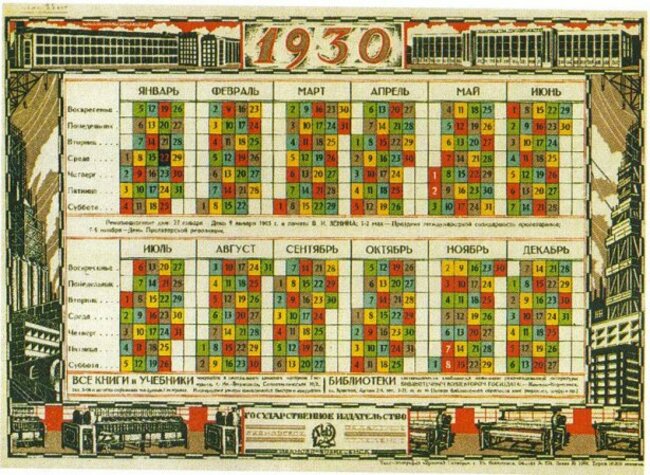
A 1930s Soviet calendar, colour-coded to show different sets of workers off for 20 per cent of the week.
Image: Business Insider via Cellenda.com

THERE IS A remarkable overlap between the ideals of the 1936 Soviet constitution and Google’s employee benefits.  Both provide the right to productive work, rest, and leisure; health protection; care for your old age and during sickness; housing, education, and cultural benefits.

That one of those entities became a world-straddling superpower with an enormous impact on global culture, economic development, and thought (and controversy), and the other folded up shop on Christmas Day 1991, is a testimony to the difference between Reward and Punishment as motivating principles of human achievement.

Interestingly, the Soviets even had “20 per cent time”, the innovation that Google has uses as an employee motivational tool. (That “20 per cent time” is the time that Google gives to its engineers to develop their own pet projects.)

The Soviets wanted to create the “новый советский человек”, or New Soviet Man, who would transcend limits, achieve heightened consciousness, attain a new plane of human development, yadda yadda.

Inevitably, these types of experiments in forced utopianism devolve into a cult-like messing around with your food, sleep, and time-keeping: it makes it easier for the unenlightened noobs to get with the program if physiological exhaustion curtails critical thinking.

So it wasn’t much more than a decade after the Revolution that the Soviets experimented with altered bio-rhythms and heightened capital equipment utilisation by introducing the five-day week, as seen in this 1930 calendar:

30calendar

The immediate purpose behind the short-week calendar was enabling “continuous production” in which factories stayed open 365 days throughout the year.  Not closing for the weekends meant no wasteful idle time for the machinery. And more stuff produced meant more record statistics for the apparatchiks to hail.

To accommodate the all-too-frail human flesh required to operate that continuously-producing equipment, the Soviets created the five-colour-encoded calendar above.  Under this calendar, 20 per cent of the workforce had any given day off , depending, of course, on which colour they’d been assigned.

Predictably, the whole thing didn’t work.  Human beings don’t perform highly under conditions of forced labour, forced productivity, or forced relaxation.  The Soviets fiddled around with the five-day calendar from 1929 to 1931, at which point a six-day continuous week was introduced, until finally scrapping the whole thing in 1940.

Instructively, the same workforce that failed to do much of anything during the forced-production-1930s became the actual engine behind the defeat of Hitler in the 1940s because their motivations became, well… their motivations: their own love of country and hatred of the enemy.

It is also, I think, why Google’s benefits (and 20 per cent time), superficially similar to the Soviets’, nonetheless produce an entirely different outcome.  Humans motivated by their own desire to contribute, to create, to “organise the world’s information and make it universally accessible and useful” and to use to their own talents borne, developed, and mastered, to do so, will create beautiful, useful, delightful products for the rest of us.

Among free people, Reward will always, always defeat Punishment.

By Marc Cendella, The Ladders

Read more articles like this on Business Insider>

  • Share on Facebook
  • Email this article
  •  

Published with permission from:

Business Insider
Business Insider is a business site with strong financial, media and tech focus.

Read next:

Comments (11 Comments)

  • In Soviet Russia, Google searches you…

    Reply
  • Do you know that in Soviet Russia if you had no job you were facing prison time

    Reply
  • Most civil servants, particularly the ones that work in local authorities, have 20 percent time.

    Reply
  • I was just thinking today with the collapse of capitalism now it’s time to rethink our whole philosophy don’t get me wrong I have embraced capitalism with my own business in the past it seems that we have sleepwalked into this far right experiment which has collapsed and we are left to pick up the pieces , I think there is a worldwide movement back to socialist principles, the Russian experiment as mentioned didn’t reward the individual only the mass state I think proper health services, education, housing, are the real values we should strive for everybody instead of been brainwashed by most multinational corps into believing as gecko put it, greed is good , how we do it I don’t know but on an individual basis we must change and shape the future so hats off to forward thinking corps like google ect .

    Reply
    • angryzes 28/04/12 #

      It’s all true but on top of that, there was ideology, final goal was to build bright future for the Humankind. As stupid as it sounds but that made this extraordinary country a reality. What kind of ideology we have now? What is final goal, as of me, if you put religion aside – I see only darkness in the future. Post modernist end of the time.

      Reply
  • lesenfantperdy, I’m glad you cleared that up. I wouldn’t want anyone to think that public servants were even more useless than civil servants.
    I hope you didn’t use up some of your 20 percent time coming up with your highly intelligent response.

    Reply
  • Angryzes,..yes I know..it means that it wasn’t that bad at all.

    Reply

Add New Comment