Business ETC uses cookies. By continuing to browse this site you are agreeing to our use of cookies. Click here to find out more »
Dublin: 12 °C Friday 24 May, 2013

Bond auction sees Ireland’s cost of borrowing fall dramatically

The NTMA successfully raises €500 million at a cost far lower than two months ago.

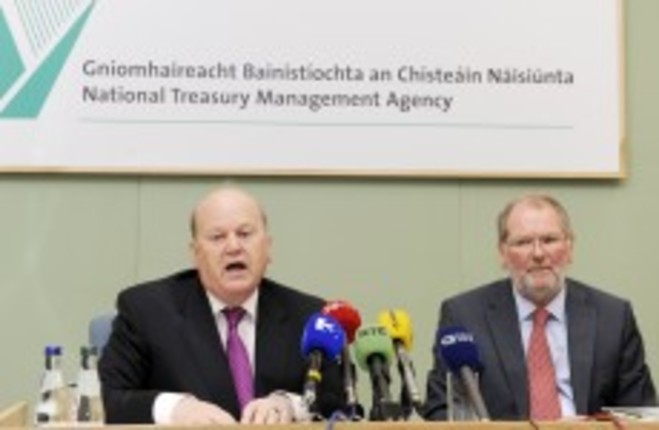
Minister for Finance Michael Noonan (left) and Chief Executive of the NTMA, John Corrigan, will be pleased at the outcome of this morning's auction.
Image: Sasko Lazarov/Photocall Ireland

Updated, 10:56

IRELAND HAS RETURNED to the bond markets today for only the third time since entering an EU-IMF bailout – raising €500 million through the sale of short-term bonds.

The National Treasury Management Agency said the auction had resulted in it paying a ‘yield’ (or interest rate) of 0.70 per cent.

That interest rate is down significantly on the yield paid after a similar auction two months ago, when investors demanded an average interest rate of 1.8 per cent.

The NTMA said demand for the short-term bonds, known as ‘treasury bills’, was 3.03 times the amount on offer.

Finance minister Michael Noonan said the result “once again highlights the improvement in market sentiment towards Ireland”.

“It is clear that the markets are reacting very positively to the June 29th commitment [of Eurozone leaders to split Ireland's bank and sovereign debts] and positive developments in Europe,” he said.

The prospects of a more favourite rate took a boost yesterday when the price of borrowing on the second-hand markets came down after Germany’s top court rejected a challenge to the Eurozone’s new permanent bailout fund.

The cost of a one-year loan – which had stood at almost 10 per cent a year ago, and over 5 per cent only three months ago – closed yesterday at 1.35 per cent, having fallen dramatically as one of the last major legal barriers to the ESM was removed.

When Ireland had issued its last three-month bills, the interest rate stood at 4.28 per cent.

Read: NTMA chief: It’s looking good for ‘sustainable’ re-entry to markets

Read next:

Comments (72 Comments)

  • Have a break. Have a diktat.

    Reply
  • The faster Ireland can shake of the diktats of the troika, the better. Getting back into the bond markets is the quickest way to do that.

    Reply
    • We signed up to the fiscal compact we will not be getting away from diktats issued by powers outside of Ireland any time soon regardless how quickly we can return to the markets.

      Reply
    • We will be all the better for external diktats. It was their absence that got us into this mess in the first place.

      Reply
    • We never exceeded the spending guide lines as laid down by Maastricht unlike a number of other countries. Fat lot of good that did us.

      Reply
    • Very true but the future diktats will include things like oversight of the banking system, which we sorely missed in the past.

      Reply
    • Well the root of the problem is the inefficiency in running the country , we shouldn’t have to keep borrowing so much , spending 50 bn a year running the island and only generating 32bn is madness , continuing to pay levels accross the board from mayors , college presidents , football chiefs (360 000 ) , consultants , radio presenters ( 500 000 for weekend presenter ) just insane , for the amount we spend we should be getting world class health services etc not the grossly over admin managed crap we hear about daily , it’s great the bond prices are down , but major reform is still needed to drive the excess ,waste and inefficiency out.

      Reply
    • Orion 13/09/12 #

      @Kerry Blake

      yes we did…

      Reply
    • Problem is Dave,
      You’re right about the shite management of the health system – and it has been poorly managed since long before the financial shite storm started,
      I suspect they wont be able to reform the health system properly just by cutting madly – investment is needed and that aint going to happen at the moment. The health system needs to be changed significantly – things like enhanced primary care, better home care and other measures to help people stay out of hospitals. And this will require spending, but proper spending – not wasting it on too much admin and management staff

      Reply
    • its not excess waiste its the coperate tax rate the large coporations arent even paying the 12 percent they nearly wrote the tax laws here they hardly pay anything into this country.

      Reply
    • Cheer up Chris don’t be so serious all the time, the poor lad was just saying he didn’t know what a tracker mortgage was!!

      Reply
    • Very good post, Dave Hammond. The country was totally mismanaged & the Cork Lord Mayor on E200k a year. What ??!! I agree with you, Richard Crompton. A sense of humour is indeed needed.

      Reply
  • A very positive development, particulary at those yield prices. A small tentative step towards getting the Troika out of here. Long way to go yet though but this is good news for a change.

    Reply
  • An interest yield of 0.70.. On Bonds .. I thought Bond was 007..

    Reply
  • Does this mean we can go back to buying (still) overpriced houses in Cavan ?

    Reply
  • The real question is what are we going to do when the Troika leave to ensure that we don’t ever end up in the same predicament again?

    Where is the big thinking on a new regulatory system?
    Where are the revised arrangements for State budgeting and spending?
    Where is the consultation with the people on the long-term structures that are required to plan for a better future?

    As the saying goes, those who don’t learn from history are destined to repeat it!!

    Reply
    • The thinking on the banking regulation is that the ECB wants to take on that role so that it can coordinate banking regulations across Europe. However many European countries don’t want to hand over that sort of power to the ECB so not sure what sort of progress we can expect on that in the short term.

      State budgeting and spending are now going to be regulated by the Fiscal Compact which should limit the amount of deficit borrowing we can do although from what I understand it still technically wouldn’t prevent another bubble like the property one.

      Don’t think there is anything moving centrally on the long-term structures which is a pity although probably not really possibly given that Governments can change from term to term and different Governments may have different priorities. No Government is going to want to be put into a financial/planning strait-jacket by a previous regieme so this will probably remain the remit of different Departments and quangos.

      Reply
  • Lol… at the fools thinking that the rate is falling out of chance… It’s a direct result of the action we are being encouraged to take in exchange for bailout money. If we abandon the program as soon as the EU leave, they won’t be back to help us again. It’s will be a full on invervention at the hands of the IMFor default and poverty for all … Half the public workers will be laid off overnight, taxes will be upped 20-30% and we’ll be kicked out of the euro.

    Reply
  • Wonder who bought those bonds. Any way to find that out Gavan?

    Reply
  • This must be bad news!!!!!! If the comments on j.ie are anything to go by….. Its pathetic..

    Reply
  • I have to admit something here. Its all double dutch bank speak to me. The new financial language we are all forced to learn because banks destroyed the country.

    Reply
  • Thanks Germany , we owe ye big time!

    Reply
  • Back to market on basis of ECB debt buying. Circular reasoning methinks.

    Well cant wait for the FG hacks to claim victory and credit here.

    Reply
    • Also, speculation that Irish banks are being strong-armed into purchasing Irish government paper, while failing to provide credit into the domestic economy. Without transparency it is impossible to know if this is progress or simply adding another couple of floors to the economic tower of babel.
      It has hard to imagine genuine investors being enthusiastically buying Irish bonds or T-bills given the continued contraction of the economy and precarious nature of the government finances.

      “After all the unattributable spinning, a real person, John Corrigan — the €400,000 (plus) boss of the NTMA — appeared on RTE’s News at One with Sean O’Rourke. Following the build-up of phoney uncertainty, Corrigan surfaced to take a bow. He accepted the plaudits with practised humility. He was “pretty pleased” that the bill had been “substantially oversubscribed”. He was “pleased with the rate”. Indeed, he insisted that the “primary dealers” all say that there was good interest from the traders in continental Europe. John sounded so surprised.
      Perhaps there really was interest from overseas. It is difficult to know. There are conflicting views. On Friday, Alan McQuaid, the ace economist who was swooped on and recruited by Merrion Stockbrokers, when Bloxhams went for its tea, told me: “I’d say a lot of it is domestic.”
      My guess is that he is right. Back in January, the NTMA attempted to swap bonds due in 2014 for similar products dated 2015.
      Despite hopes that foreigners would bite the bait, the issue was supported by native banks — most of them state- owned. Not a hard sell, just a bit of arm-twisting.
      We will probably never know what happened behind the scenes, or how much the NTMA spent on spinning a good yarn about last week’s deal. Its inner workings are a secret, still protected from the Freedom of Information Act. It remains unaccountable, a master at behind-the-scenes operations.
      Nevertheless as Kinsella put it so eloquently: “You cannot win a PR war with bullshit.”

      Shane Ross

      Reply
  • I really don’t think most of the Irish bankers know what the actual transaction are or what the technical aspects of banking are. They simply put their hands up after all this time and say WE DON’T KNOW WHAT WE ARE DOING.

    Reply
    • Ha ha yeah m like the guy on the upstairs of the bus in the ad ” I didn’t know what a tracker mortgage is” and it turns out he was actually working for the bank ;)

      Reply
    • Frank yes they bankers know exactly what they are doing do not be fooled by the lies this goverment are spinning

      Reply
    • So true Frank – they seem to have no idea of the fundamentals of money mechanics. The whole nation including its politicans, civil servants and economists do not understand how we are being stripped of our wealth. And how would they? This stuff is not thought at school, in universities or is in economic media. There is much confusion caused by throwing around banking techno terminology, but maybe this is the point.

      If you have 3.5 hours and want to really understand then watch this film:

      Segments: The Problem; The Money Changers; Roman Empire; The Goldsmiths of Medieval England; Tally Sticks; The Bank of England; The Rise of the Rothschilds; The American Revolution; The Bank of North America; The Constitutional Convention; First Bank of the U.S.; Napoleon’s Rise to Power; Death of the First Bank of the U.S. / War of 1812; Waterloo; Second Bank of the U.S.; Andrew Jackson; Fort Knox; World Central Bank

      http://www.youtube.com/watch?v=HfpO-WBz_mw

      Reply
  • So they are borrowing to pay back what they already have been lent?

    Like, if a small company did that, receivers/examiners would be circling.

    Here we go again me thinks!!

    Reply
    • No …we are borrowing to provide services we cannot afford in Social Welfare and Health principally and pay salaries in the Public Service that are fifty per cent higher than in the Private sector.!

      Reply
    • Governments constantly borrow money. They just need to do it in a sustainable way and a reasonable rate. The idea is that growth in the economy keeps the overall debt level at manageable proportions.

      Reply
    • Mick,
      A lot of what you say i tend to agree with but in this case, I think you will find those figures are very skewed…. truth is the vast majority of workers in the public sector are highly qualified with degree’s etc. So a better way to compare would be compare an enginneer working for the council with and engineer working for a private company….Think you will find the gaps are not as severe. Reason for the big differnce is that the private workforce has a very percentage of unskilled labour who have very low levels of pay thus bringing the overall value down…
      D

      Reply
    • 21% premium for Irelands public sector (not including pensions) compared with 5% in UK and 0% in Germany and Finland.

      “Last year, research published by the German Macroeconomic Policy Institute (IMK) shows that in 2010, the average hourly labour costs (including social security costs paid by private sector employers) were €28 for the Irish private sector and €34 for the Irish public sector.

      The rates for Germany were €29 per hour in both sectors; Finland’s rate was also €29 in both sectors and the UK was €20 per hour in the private sector and €21 per hour in the public sector.

      So the Irish public sector had a premium of 21% before accounting for the benefits of the special pension scheme.

      ‘The National Strategy for Higher Education to 2030’ report which was published in January 2011 stated: “Salaries account for three-quarters of total current expenditure on higher education in Ireland – compared with an international average of two-thirds. This means that Irish higher education operates with lower (nonpay) recurrent expenditure than is typical in other countries.”

      Last April, the Department of Finance said that while taxation receipts in 2012 are projected to be just above 2004 levels, the gross voted expenditure of Government Departments and Offices in 2012, at an estimated €56bn, is projected to be 37% above the level it was in 2004, despite the very significant adjustments to both revenues and expenditure since mid-2008.”

      Reply
    • Sean,
      I hear you. Please show how Irish private sector pay compares with the countries mentioned!!! I think you will find that our private sector gets paid way more that their european counterparts…. This is where the media fail us….
      I work in the private sector by the way…
      D

      Reply
    • Well said Declan, too many idiot economists go for the easy shot at public sector workers, forgetting that they went to college and studied when others took the quick bobs on a building site and now feel stupid and bitter for doing so.

      Reply
    • Thanks Declan.
      According to IMK’s survey:
      €28 per hour for Irelands private sector
      €20 for UK
      €29 for Germany and Finland
      Was that your query?

      Reply
    • i guess it does Sean. looks like its much cheaper to employ people in the UK than Ireland which I think you would agree is the best match in terms of culture, demographics etc. So If the private sector worker in the UK gets less than his Irish counterpart….surely we can not be suprised that the public sector shows similar trends?

      Reply
  • Well at least the germans are happy

    Reply
  • It is time for every mortgage holder in this Country to grow a pair and stop paying their mortgages put manners on these bastards for once.

    Reply
    • How would that help? Families would be evicted and, even if it it hurt the banks, the hurt would be passed on to the banks’ owners, ie, us. The only people in our society who would benefit would be the lawyers.

      Reply
  • Here is the solution to the problem of money needed take back our natural resources and get a better deal !!! http://www.myoil&gas.org watch this it will make you sick .

    Reply
  • €500 million – that will cover our excess spending for about 10 days. Brilliant. The debt cancer grows a little more.

    Reply
    • So what are your solutions? How exactly would you cut the €15-€20 billion gap between our spending and our income?

      Reply
    • Good question Jim – It’s very easy to be negative and type our frustrations at government failures.

      Here’s what I would do to recover our nation:
      1) Dump the Euro, banking guarantee scheme, bank recapitalisations “bailouts” which honouring our genuine sovereign debts for which we actually received money. The euro is NOT required to trade with Europe – eg. UK, Switzerland, Sweden.
      2) Control our own money supply with the punt – stops the senior bond holders/central bank owners flooding and contracting our money supply to bust our economy and buying up everything for peanuts)
      3) Limit and reassess the fractional reserve banking system of our money system
      4) Set up a national resource council protected from political/financier interference to control our oil, gas, forestry, national infrastructures.
      5) Get help from Norway, Brazil, Venezuela to harvest our huge oil and gas reserves.
      6) Blanket national debt write-down
      7) Blanket wage reduction – especially of the ones mentioned above.
      8) Let public servants organise their own pensions
      9) Public/community work schemes for all those receiving social welfare – renamed emergency employment income.
      10) Cut health spending massively with preventative medicine. Even consider prohibition of cigarettes – the first country to implement it. Mortality tax on junk food. Accountability for illness certifications which is grossly abused. Nominal payment for all health services. Completely free of charge services are disrespected.
      11) National self sufficiency as far as possible using sustainable energy, agriculture, building materials etc.

      Reply
    • @ Oliver – some of what you’re suggesting may help in the long-term, but creating a new currency and burning bond holders would cause a level of short-term pain that would be too high to survive.

      Reply
    • Nikolas – we need to learn from what Iceland and the South American countries did – they confronted and threw out the blackmail and tyranny of the IMF/World Bank. We caved into the threats and did everything they forced us to. We fell for all their tricks due to ignorance of the game.
      What I propose is incredibly radical and would require a complete reset of our society.
      There certainly would be a lot of pain including loss of our bank deposits. It would be a sacrifice for future generations of this nation. Otherwise we hand a debt burden so great to future generations that they will not own any part of their land. They will be slaves to a global empirical banking titan.

      Reply
    • Iceland is a country with 230,000 people and an independent currency. The South American countries have, bar a few exceptions, spent the last few decades going through a hell of poverty, inequality, corruption and domination by extremely violent organised crime. so your first comparison doesn’t hold water and the second is not something I would wish on the people of this country. You’re good with the overblown rhetoric, I’ll give you that, but rhetoric won’t pay for food, light, heat, education and health. The question you have to credibly answer is; where would the money come from. Until you can convincingly answer that, you won’t have a leg to stand on.

      Reply
    • Stop comparing Iceland to Ireland. There are two completely different scenarios.

      Iceland did not have a huge fiscal gap to close when its banks collapsed and still doesn’t have that gap so it could ensure that it didn’t have to cut its public spending although there were cutbacks but they didn’t have to go anyway as deep as we had to.

      As for dumping the Euro, the Euro and the backing from the ECB is the only thing that is keeping this country anyway afloat at the moment. I’m tired of people constantly suggesting this as if it was some sort of magic wand solution to all the country’s problem. The opposite is actually the reality. Let’s consider the implications of what you are suggesting.

      Firstly any default of any kind would create huge negative repercussions for Ireland. The bond markets won’t care if we claim we’re only defaulting on unreasonable debt. All they will see is the word default and therefore our yields will rocket making it completely impossible for us to borrow money. We won’t be able to call in the IMF because they have already lent to us and we won’t have any recourse to European funds because we will have to leave the Euro. As we’d probably be frozen out of the markets the only thing we could do is eliminate our need to borrow immediately.

      We’d also have to create a new currency from scratch while in the middle of a financial crisis. Those whom we weren’t defaulting on would demand that our debt stay in its issuing currency which would be Euros. However any new Irish punt would devalue hugely against the Euro (Iceland’s currency dropped by almost half its value) so instantly our debt would potentially double in real terms and probably more because the chances are that our currency would devalue more because we would be in a weaker state.

      In order to try and defend the new Punt the Central Bank here would have to raise interest rate to huge levels (Iceland has Central Bank rates of over 10% for almost three years). That would mean that mortgage would rise to similar levels which would be completely unsustainable for the majority of mortgage holders. Therefore there would the risk of massive mortgage default which probably would just destroy the entire banking sector. So on top of a currency crisis we would most likely have a banking collapse and the possible loss of the savings people have in Irish banks. Currency controls would have to be introduced to stop the flight of money out of the country.

      A devalued currency also means that the cost of all of our imports would rise, again probably quite vastly depending on how much the currency would devalue. This would push up the cost of electricity, food and services so now we are adding inflation into the mix. Exports might get a temporary boost but because the cost of manufacturing will rise that boost will be limited. Also because credit lines would probably cease to exist manufacturers would find it very hard to bridge the gap in supply and payment. Tourism would probably be the only bright spot because Ireland would become a cheap place for external holidaymakers as their currency would go a lot further.

      The government could try and print money to bridge the fiscal gap because we couldn’t borrow but printing money in a devaluing currency is a recipe for hyper inflation. Therefore it could only print limited amounts of new money. And even if the government printed money we’d still not be able to print enough to cover the fiscal gap so we’d have to introduce huge cutbacks in public services and wages. Indeed you’re suggesting this anyway. This would have the effect of deflating the economy as people would have no money to spend on anything but essential services.

      So now we have a potential perfect storm of a devaluing currency, high interest rates, banking collapse and increased inflation in a stagnating economy.

      Most of your other suggestion are also unworkable in the context of leaving the Euro.

      Your suggestion that we limit what foreigners could buy in Ireland is unworkable because having our own currency actually increases the likelihood of foreigners buying Irish property and companies. And because the Irish government would be desperate for foreign currency to come into the country we couldn’t afford to limit that flow.

      Things like oil and gas harvesting would be completely off the agenda because we wouldn’t have the money to invest in such resources. It costs billions in research and development. Unless of course your suggesting that we just give it to the Norwegians, Venezualans and Brazilians which is probably what would happen.

      Letting public servants look after their own pensions could not just be introduced overnight because it would be illegal and probably unconstitional. And even it we were able to force it through it would have to be on a scaled basis because otherwise it would throw the older section of the public service into poverty because they wouldn’t have prepared for this. It would be morally indefensible. It would also create massive industrial unrest which would probably undermine the economy even more.

      A blanket national debt writedown just increases the likelihood of a banking collapse and even if they didn’t all is does is move the problem not solve it. That money doesn’t just disappear. Because we own most of our banks all we are doing is pushing the debt back onto the taxpayers. We also probably would find that foreign owned banks would challenge a forced writedown. So we’d have to in effect nationalise all foreign owned banks as well. Not really a recipe for encouraging investment into the country.

      Preventative health care is a good idea in the long term but it requires a lot of money upfront which we wouldn’t have. And national energy self-sufficiency is a pipe dream because we simply don’t have those sort of resources and even if it was attainable it would require vast amounts of infrastructural spending that again the country couldn’t afford.

      So I’m sorry but I don’t think much of your suggested solution to our problems.

      Reply
    • That was way too long a comment but once I got started I couldn’t stop!

      Reply
    • @Nikolas – Thank you for your ?complement ;) regarding my rhetoric. But when you see your country being stripped in front of your very eyes, it’s hard not to get vocal and upset about it. In my defense I try to contribute solutions too!

      I’m not sure why Iceland having 1/20 of our population nullifies the opinion that we should dump the fraudulent debt placed upon us. The fact that Iceland is independent of euro is also be one of the reasons it can recover again – because it can control its own money supply – and we cannot as long as we are enslaved by it.

      If you are suggesting the gang drug wars of some Central American countries would be the result of confronting the IMF/World Bank then I can’t take your suggestion seriously. The hell of poverty in these countries is directly as a result of the IMF/World Bank and Corporate North America stripping these countries of its assets.

      @Jim Walsh – You certainly do provide a detailed response to all my suggestions. I am highly surprised that, in your opinion, NOT ONE of my suggestions has any merit (And I hope that am not being egotistical in my defense!). This is highly suspicious.

      If you genuinely believe that the course we are currently persuing is the absolute best, then I honestly feel that you are being blinded by those who are completely manipulating us. I would recommend reading the true stories of the countries that the IMF have dealt with. It is shocking.

      You need to realise that the power of those who control us through the ECB and Euro can be severed by knowing how the money system works. You treat them like God-like entities that are have the global exclusive to control and supply money systems. They are not. We need to wake up to this fact (More wooly rhetoric :D)

      I fell that we will continue to disagree but is that not the function of forum discussion? Keep informed :)

      Reply

Add New Comment