Business ETC uses cookies. By continuing to browse this site you are agreeing to our use of cookies. Click here to find out more »
Dublin: 10 °C Tuesday 21 May, 2013

IMF turns up heat on demands for Irish bank debt deal

The latest IMF quarterly review says having the ESM take a direct stake in Irish banks is the best way back to the markets.

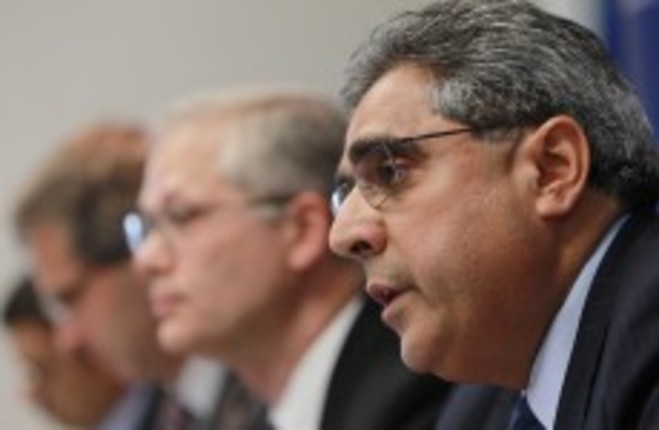
The IMF's Ajai Chopra: the best hope for Ireland getting back to bond markets is if European leaders implement a deal to split Ireland's bank debts from the Irish state.
Image: Julien Behal/PA Archive

THE INTERNATIONAL MONETARY FUND has upped the ante in the talks on a deal to split Ireland’s banking debts from its sovereign debts, calling on the Eurozone’s finance ministers to implement a previous agreement without delay.

The IMF’s latest quarterly update on Ireland’s progress under the bailout repeatedly refers to the deal reached by European finance leaders on June 29, when it was agreed that ministers would take whatever measures were necessary to split the banking burden from the sovereign one.

The report, published this afternoon, outlines that the best-case scenario for helping Ireland return to the bond markets is for the European Stability Mechanism to take an equity stake in Ireland’s banks – effectively meaning that the ESM would match the money invested in the banks by the Irish state, freeing up Ireland to take its own investment back out again.

In the report, the IMF writes that breaking the link between the banks and the state is the single most important task to “improve the sustainability of the well-performing adjustment programme”.

“Material investments in Irish banks by the ESM could transform the public debt outlook, cut the bank–sovereign link, and cement a needed win for Europe,” it bluntly states.

“More broadly, Ireland’s policy programme is sound and adjustment is being delivered, providing strong prospects for program[me] success. These would be improved by more benign market conditions and more effective policy action at the European level,” it later adds.

The report is positive about Ireland’s progress to date, halfway through the EU-IMF lending programme, and notes that Ireland’s deficit reduction plan was ahead of schedule by the end of July – but added that similar progress in 2013 could be undone by further financial risks.

The government had done commendable work and had ”restored policy credibility, but risks to outlook remain substantial,” the report said. “Ireland must continue to deliver on the many difficult steps needed to underpin a sustained economic recovery.”

Europe poses risk to recovery

Though the report remarks that lots has been done to stabilise the economy and begin to bring Ireland back to the bond markets, “public debt is high and still growing” – while the banks are still not supplying the needs of households and SMEs.

It later adds that “deep and sustained financial sector reform efforts are needed to restore banks’ ability to support sound credit and revive domestic demand” – adding that it was vital for the banking sector to return to profitability so that lenders were encouraged to offer credit to households and businesses.

With the debt crisis continuing to cast an uncertain future on the outlook for the Eurozone, exports are also at risk – meaning the overall economic recovery remains very risky.

The report sees the IMF rein in its projection for Irish economic growth in 2013 – from 1.9 per cent to 1.4 per cent, largely as a result of a drop in demand for Irish exports as the economies of continental Europe continue to stutter.

IMF country director Craig Beaumont told a conference call of reporters that there was no ‘Plan B’ for alternative funding for Ireland if it had not regained market access by the time the first funding package had run out.

Asked by TheJournal.ie if a contingency plan was in place should the German constitutional court rule that the ESM is illegal, Beaumont said the current plans were being applied “very vigorously”.

“We’ll come to that hurdle when we reach it,” he said.

Read: Ireland making ‘such good progress on all fronts’ – Van Rompuy

Read next:

Comments (56 Comments)

  • Never thought I’d say this but I’m glad the IMF are here
    They have been a lot more supportive than some of our so called partners in Europe

    Reply
  • Is it just me or are the i.m.f. suggesting what our minister of finance and Taoiseach should be doing.

    Reply
  • JakkiB 10/09/12 #

    The IMF are on to the corrupt banking system that has operated in Ireland between government and our banking system and is that not what the people want??? The debt where it belongs with the banks and not the people!

    Reply
  • Do we have an official response from our Government to this statement…….or has it not been faxed over from the Bundestag yet?

    Reply
  • So when the privately owned banks are bust and need to be recapitalised – ie bailed out with debt on taxpayers – they are put into state ownership. Then, when they are recapitalised, they are handed back to private owners.

    Are the department of finance completely retarded???

    As a general rule – What the IMF, ECB and World Bank says, do the complete opposite.

    Reply
  • The IMF are not happy with the lack of action on the bank debt deal- that’s not necessarily a reflection on Ireland.

    “More broadly, Ireland’s policy programme is sound and adjustment is being delivered, providing strong prospects for program success”

    I think that’s a strong endorsement of Ireland’s side of things.

    Reply
  • It seems to me that the IMF are starting to grow rather weary of the EU’s inability to make any kind of a decision on anything ever! It is constantly foot dragging, in-fighting and kicking the can down the road.

    It is partially just the nature of the beast – The EU is a cumbersome body that is really just a complex intergovernmental organisation with a very weak parliament bolted on. It seems to lack the tools to deal with the crisis and even if it did have them, it would lack the democratic oversight to make them legitimate unless it were completely redesigned from the ground up.

    However, there has also been extreme intransigence from various countries and an inability to cooperate in a meaningful way. Governments are playing to nationalistic, right-leaning / left leaning electorates in various countries and the media (and sometimes the political) debate seemed to get down to xenophobic name calling with offensive terms like ‘PIGS’ being thrown about, while some countries facing problems are incapable of seeing that they had major systemic flaws themselves and are blaming Germany and throwing around all sorts of nasty media caricatures too.There are unfair accusations of laziness, accusations of imperialism and unwarranted attitudes of superiority etc etc. That really has not helped to open a public discussion on what is really going on or what the systemic weaknesses in the Eurozone are and how we can resolve them.

    When push comes to shove, many EU members seem to be quite capable of adopting an “I’m alright Jack” attitude and retreating to positions that only help their national interest. Instead of solidarity what we have seen is EU members being reluctantly dragged into positions of vague support for their neighbours under threat of fiscal Armageddon. The problem with that is that the economies are now so bound together that its a case of all hanging together or the markets will hang us all separately, probably starting with Greece and them moving down the line until they collapse the Euro entirely.

    Eurozone members and the EU decided to bolt their economies together, nobody forced them to. There was always a risk that the project may have issues and that things could go wrong. In fact, this very scenario was more or less forecast by quite a few commentators and economists who were skeptical of the single currency project from the outset.

    It is a bit like one of those financial services adverts. It should have come with a disclaimer : The value of the Euro and associated costs may fall as well as rise!

    I am really starting to think that this crisis will either make or brake the EU as we know it. It will either end up totally reformed and functioning or else fiscal / financial integration will have to be rolled back.

    I wonder if the IMF really knew what it was letting itself in for when it got into bed with the European Commission and ECB??

    It’s starting to look like the ‘Trokia’ may be far less ‘together’ than we thought.

    Reply
    • The group that came up with the Euro warned the Eurozone countries that they were’t ready to switch, that many countries didn’t have their finances in order and it wouldn’t work – but they pushed ahead with it anyway. I don’t think the EU bureaucrats have the intelligence or force of will to sort this out. They’re just going to keep pressing on the people of Europe to throw money into the bottomless pit until the whole thing falls apart.
      It’s not even that people are looking at protecting their own countries, I think they’re only looking after their own personal interests.

      Reply
  • Can anyone say who will own AIB and PTSB if the ESM take Over the debt? This may not be without a downside. How will the boards be populated? Will they be more likely to give loans? Why?

    Reply
  • The IMF devastated south america in the 70s & 80s and south america was just starting to come out of it when the recession hit 5 years ago, they are only getting started here.

    Reply
    • So Ray
      Our problems were all caused by the World Bank?
      You need to stop stoking that stuff . It’s really bad for you!

      Reply
    • Not all Mick, but if you think they are our friends you must be smoking yourself. I would highly recommend a book called “Confessions of an Economic Hitman” by John Perkins. He was an agent who went into countries and plunged them into debt by giving false economic advice. They then extract all the resources from those countries. Here’s a sample: http://www.youtube.com/watch?v=xLe9u9SffO0

      Just talked to a FG member at their conference in the West, he tells me the IMF are “batting for our side against the ECB” – oh dear…

      Reply
  • Chopper for Taoiseach

    Reply
  • It’s pretty 50/50 at the moment as to whether we’ll get a deal on the bank debt I think.

    Although there were promising reports earlier in the year on such a deal being struck, and with the IMF now getting behind this idea to fast-forward our return to the markets, we need to put ourselves in the shoes of the EU.

    Ireland is actually fairing very well and hitting all the targets so they’ll be thinking ”They’re doing fine as they are, paying everything back on time without any help. If we give them help, everyone else will expect it too. Let them pay back every cent, no deal for them.”

    The only way I can see us getting a deal is if the IMF forcefully intervene. And hopefully, they have more say on this deal than the EU. Maybe next year we can expect a deal but we need one asap!

    Reply
    • Ireland beds this bank debt burden sorted out very quickly, because it shall hopefully give the country more time to deal with the domestic spending deficit. If the government are forced to take another€3.5 billion out of the economy in Decembers budget, then I think we will be just about finished. People just don’t have the spare cash to fund such savage cuts. It’s obvious that the hole has to be plugged, but we need more time.

      Reply
    • We need our money back, Greece is falling apart, looks like civil war may be on the cards further down the road, police and army are both splitting, more and more striking. Ireland’s not far behind if things keep going the way they are.

      Reply
    • Rodrigo,

      How in God’s name is borrowing even more money going to solve our (completely unconstitutional) bank debt burden? This is just not possible. Removing further money from our economy demonstrates exactly why we need to cut loose from the euro – our money supply is being cut off by those that control it – the ECB and its private owners. We are being plunged into poverty.
      Bring our old currency back and control its supply. Collapse our failed banks and cut our loses. It really is that simple. Our deposits will be lost but we will be free from the IMF/ECB/World Bank liquidation machine.

      Reply
  • In the report, the IMF writes that breaking the link between the banks and the state is the single most important task to “improve the sustainability of the well-performing adjustment programme”. Methinks the Irish financial institutions would much prefer to be answerable to Enda and his pals than to Merkel and Hollande who would be less influenced by Irish banks’ political donations. Expect a huge PR onslaught from our financial institutions on why this is not a good idea.

    Reply
  • Funny how particular this crap government are in adopting IMF suggestions, didn’t the IMF suggest that this utterly inept government not pay bondholders?
    What happened there?

    Reply
  • @mick Collins . You my friend have no clue , make yourself a cup of tea and watch the rest of x factor .

    Reply
  • We didn’t loose the run of ourselves , the banks did , I didn’t loose any money , I didn’t buy an investment property that I couldn’t pay for yet I had to pack up my life in Ireland and head to Australia .

    Reply
  • It’s past time those blood sucking,money grabbing,soul and country destroying gobs8ites were told where to go.

    Reply
  • I’m pretty sure they are batting for our side , and no prizes if you guess who we still have to pay back with any money that the Irish government might be able get…they are no fools , they know we are smashed and it’s unlikely we could make it without that deal restructured and they would be taking a hit….

    Reply
  • Why the hell are we paying out our backsides for the greedy politicians of this country and the bankers, it’s their mess…they make a lot more than we do so why the hell aren’t they taking the payouts. Nothing but corruption in the dail and the banks and making the average joe soap pay for their overspending and the banks idiotic lending. There is approximately 4 Million people in Ireland. On September 1st 2012 1BILLION EURO went to one unsecured bondholder (paid by us), that works out at €250 from every person in this country. Now there,s €64.1 BILLION that is the BANKS AND GOVERNMENTS fault which means that €16,000 from each person in this country will be put back into the RECAPITALISATION of the banks, nevermind paying off the IMF! , ESMS etc with their interest rates.

    In 2011 Ireland’s GDP (gross domestic product) was 41%.
    In 2012 Taoiseach announces he wants to reduce to 3% by 2016.
    This means taking €13 BILLION to give to BANKS, BONDHOLDERS and GOVERNMENTS. (which will be taken from every average citizen of Ireland, EXCEPT for the high rollers who earn €211,000 a year :maybe more, maybe less: .

    Now the people of Ireland were never given a choice in the “blanket guarantee” and now we,re not being given a choice in gettin our money cut down to the bare minimum while the jokers of the government, banks, bondholders swan around on their nice big wallets yet they can’t take a paycut???

    How is this fair??????

    http://www.change.org/petitions/supporting-the-irish-nation-step-down-from-government

    Reply
  • So the ESM will take an ‘equity stake’ in Irish banks …. Giving them direct access to collecting ‘their’ debts….

    Reply
  • The best thing that could have happened would be break up of euro zone in 08. Sure our banks would have gone. So what? Look at Iceland. Seem pretty stable now and we are still in this mess with very little in the way of help from our European friends.

    If I’m right or if I’m wrong fair enough but one thing I am right in is all this will happen again. 20 or 30 years down the road we will lose the run if ourselves and be back in same mess again.

    Reply

Add New Comment