Business ETC uses cookies. By continuing to browse this site you are agreeing to our use of cookies. Click here to find out more »
Dublin: 7 °C Wednesday 22 May, 2013

Greece’s new best friend: France

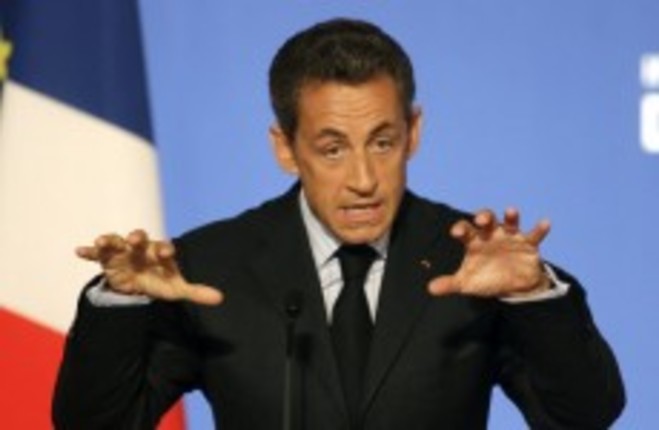
Sarkozy has pledged that France “won’t let Greece fall” as he announces French banks’ support for debt-laden Greece.

Image: AP Photo/Michel Euler

FRENCH BANKS are ready to help troubled Greece by accepting a significant debt rollover, President Nicolas Sarkozy said today – a move that could push other banks to pitch in to the Europe-wide effort to keep Athens from defaulting.

French banks are among the biggest holders of Greek sovereign debt — some €15 billion — and Sarkozy urged other countries to follow suit.

Sarkozy said the plan being worked out between French treasury officials and bankers would involve reinvesting debt held by French banks in new securities over 30 years.

A report in Le Figaro newspaper says that the banks are ready to re-invest, or roll over, up to 70 per cent of the Greek sovereign debt they hold. Asked whether the report was correct, Sarkozy said “yes.”

“It’s a system that other countries could find useful,” he said of the plan.

“The idea is that we won’t let Greece fall, we will defend the euro, it’s in the interest of us all,” he told a news conference.

A Greek default would have grave consequences on all 17 countries that use the euro and rock markets worldwide. European leaders are trying to get the private sector to take part in a new rescue package under discussion for Greece.

Germany has a greater amount of Greek government debt than France. But France has a larger total amount of Greek debt because of its exposure to Greek private banks, mainly Credit Agricole’s ownership of Emporiki Bank.

The finance ministry in Germany, which has pushed hard for private creditors to contribute, said it welcomes proposals from the private sector, as in the French case.

The German government “is still in talks with financial institutes, with banks and insurers, with major private creditors, for example investment funds,” ministry spokesman Martin Kreienbaum said. He did not give details.

European countries and the IMF put together an original bailout last year for Greece. But persistently high interest rates demanded for its bonds have meant the country needs more help.

- AP

Read next:

Comments (7 Comments)

  • Of course Sarkosy won’t fall out with Greece – they are by far the biggest losers financially to the tune of 50+ Billion if the country fails.
    Sarkosy is not thinking of Greece in the long run – just home grown French investments, lets not kids ourselves.

    Reply
  • Here is why France won’t see Greece fail:
    http://img4.imageshack.us/img4/1598/ttheurope22170081a.jpg

    Reply
  • The crafty devious little dwarf is looking after his own interest as The French banks are the biggest losers if all goes wrong.

    Reply
  • Irregardless of the Greeks on the streets, the Greek politicians stand up for their country and play hardball. We don’t want to offend our “friends” in Europe or be thought to be doing anything different. That is why we followed England’s economic model for the last 90 years of statehood and rejected the model of smaller countries in Europe like Finland, Denmark, Holland, Norway, Sweden, all of whom could buy every inch of this country and are still growing strong. It is ironic that it was the EEC that forced through much of the improvements in equality, workers protection, opening up of the economy to more people rather than the golden few, actions that were opposed by FG and FF as “communist” only a few years earlier were welcomed with open arms once Brussles told them to do it.

    Reply
  • Forgetting the catastrophic terms and acceptance of the banks debt as Irish sovereign debt – what were FF thinking. But how and ever.

    Why is that when we were negotiating our bailout we didn’t demand all bondholders be burned (as they would have been in a commercial setting with 100% losses) and demand a low interest rate, and seriously threaten with default if they didn’t play ball.

    I can guarantee no one charged with the stability of european banking as a whole would take a threat like that lightly? Or this idea too vigilante-like to be a realistic position?

    Reply

Add New Comment