Business ETC uses cookies. By continuing to browse this site you are agreeing to our use of cookies. Click here to find out more »
Dublin: 9 °C Saturday 18 May, 2013

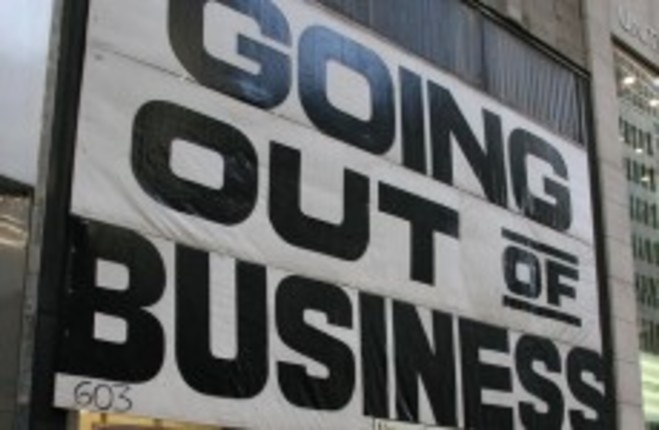
Five companies a day went out of business in 2011

The firms left unpaid debts of €1.2billion, which it’s feared could further hit economic recovery.

Image: timetrax23 via Flickr

FIVE IRISH COMPANIES went out of business every day on average last year – or almost 170 a month, new figures show.

A total of 1,930 firms collapsed between January and December 2011, according to business analysis service Vision-net. This was a 20 per cent increase on the same period in 2010.

Between them the companies left unpaid and unsecured debts of almost €1.2billion – debt which is likely never to be repaid and which could drag other struggling businesses towards the red.

“Short-term unsecured creditors are still owed €1.19 billion which has serious knock-on effects for business cash flow, employment and consumer sentiment,” Vision-net managing director Christine Cullen said.

However the figures also showed an increase in the number of new companies being registered. A total of 14,439 new firms were incorporated in 2011, up five per cent on 2010.

But there were worrying signs of further difficulties ahead, especially in the hospitality sector. According to Vision-net, just over 60 per cent of 5,000 companies analysed in the hotel and restaurant sector were deemed “high-risk”.

Hospitality firms accounted for nine per cent of all business failures in 2011.

There were also risks in the retail and motor trades, where around half of the companies analysed were “struggling to stay solvent”.

“Our figures also show that companies in the hospitality and construction sectors have been hardest hit as discretionary spending in the economy slows significantly and the property market continues to contract,” Cullen said.

“Corporate insolvencies have risen by almost one-fifth over the same period last year but the number of newly created companies is marginally up on last year showing that entrepreneurship remains a strong trait in the workforce.”

More: 140 companies closed in the last 7 days>

Read next:

Comments (23 Comments)

  • You cant brand all the public sector with the mr. cardiff brush. I work in a disadvantaged school where our staff is being cut by 25% …. Frontline workers axed again and where are the golden handshakes from a government of empty promises and lies. Hitting the most vunerable in society…… Its the ordinary workers in public and private that are suffering along wirh the kids and families affected by greed.

    Reply
  • Quite a few opportunistic voluntary liquidations and set piece “elective” insolvencies, it has evolved to become a business strategy. This would also explain some of the new company registrations also as many Phoenix from the flames liquidated companies are in effect clearing the slate leaving creditors of the old companies with a bad debt and starting afresh.

    Some business advisors actively encourage this as there are great fees to be had for receivers and liquidators. It’s a nasty little business.

    Reply
    • If companies liquidate to get out of paying creditors and reopen under a new company they still need to be supplied. It’s not a simple as you suggest. Directors are getting smarter. Instead of putting all eggs in one basket they are spreading risk. Retailers are opening one company per shop to force every location to stand on its own feet. The type of prudence that would have forced rental issued with landlords if it was previously practiced.

      Reply
    • Jay funk 03/01/12 #

      If you close a company when it’s insolvent you can’t open a new company for 6 years, what you suggest is pure crap from someone who has never been a director of a company and knows little of corporate law

      Reply
    • Jay, don’t be making up company law. A company can be insolvent for many reasons. Restrictions are only pit on directors who are found guilty of reckless trading. There is no 6 year rule. It’s all case specific and there are very few disqualifications in Ireland. Restrictions may mean placing a bond down that offers some degree of guarantee to future creditors… but that’s only if you traded recklessly. The say majority of company wind ups due to insolvency are due to insolvency.. which means they are no longer viable.

      Reply
    • If a company goes into liquidation the directors are barred from being directors of any other company for six years. AS for retailers…cormac are you talking about franchising? The six year rule still applies for directors positions but the director can be an employee of the company.

      Reply
    • Niamh… http://WWW.cro.ie You’ll find that I am correct. yourself and Jay above are confusing bankruptcy with company insolvency

      Reply
    • So what is the difference between them and what bracket do recievership and liquidation fall into?

      Reply
    • Jay funk 03/01/12 #

      Cormac from director of corporate enforcement below,

      Any director is liable to be restricted from being a director of certain companies for five years if he has been a director of a company within twelve months prior to the commencement of winding up of the company and the insolvent company being placed in liquidation.

      Reply
    • Jay, yes of course a director is liable for their conduct. Insolvency is not against the law. Trading recklessly is against the law. A liquidator must present their findings to the CRO, this includes the conduct of the directors. In some cases the liquidator will state that they wish to take a case against the directors and in some cases the CRO will instruct the liquidator to take a case against them. In most circumstances they dont because the directors did nothing wrong. The result of a case taken against a director can include a barring or for lower offenses, a restriction. A restriction means you have to put a bond in place or capitalize a company or companies by a sum of money for a period of up to 5 years. It can anything between 1 to 5 years. Very few company directors get barred. The only cases I ever saw on the CRO site was for directorate who just walk away and leave the country don’t bother to liquidate.

      Niamh… bankruptcy is applied for to the courts by private individuals, not companies. It’s actually very harsh in Ireland and Enda Kenny has stated that the gov are looking at amending the procedure.

      Reply
  • How many of the people who owned and worked in these companies have Retired with €100k plus pensions? Not a lot.
    Failure in private sector = lose your job and savings.
    Failure in public sector = Cardiff job or fat pension.

    Reply
    • I just wish you would stop generalising , I am an ex soldier my pension does not cover my outgoings and I have eaten into my savings, my next step is cutting down use of electricity and oil, have already cancelled life insurance, pet insurance and I am in the lucky bracket… So f*** you and your fat pensions.

      Reply
  • So on average each left €820k debt?! Where did they get this sort of unsecured loans from??

    Reply
    • The loans as you call them were leant or given credit by other companies. Eg if a restaurant goes into liquidation it will owe money to food suppliers cleaning companies staff revenue landlord esb rates to council etc

      And maybe also some banks

      In the end this all effects the average person through higher prices as companies will soon start trying to re coop their losses once they have burned through their war chest. In every recession just before a depression prices rise.

      Starts with semi state companies rising prices to re coop losses as they normally run monopolies can increase prices at will, this puts more companies out of business, next multinationals raise prices as they see more risk of not been paid and have to cover the risk, so more companies go under, then large Irish firms follow the multinationals as they are even more exposed to the risk, this goes through the whole cycle of companies right down to the sole trader. It’s called a depression, ask yourself have you noticed semi state and large multinationals raising the prices?

      Reply
  • Why be so negative? The article should be titled ’40 companies and day went into business in 2011’

    Reply
  • Another great article to further damage peoples confidence in general. Nearly as bad as RTE.

    Reply
  • We should all be more positive for 2012.

    Reply
  • It’s not the first time Journal puts a bad spin on a story instead of objective facts…

    Reply
  • So 170 companies close each month and 1203 companies start up each month… That doesn’t sound too bad to me?

    Reply
  • Gav 05/01/12 #

    More high potential start-ups then any other European country. Investors ready and actively putting money into Irish companies. Banks lending to small business in many cases. When are the journal going to write about that? Although negative stories, get more numbers. You’re becoming the Daily Mail!!!!

    Reply

Add New Comment