Business ETC uses cookies. By continuing to browse this site you are agreeing to our use of cookies. Click here to find out more »
Dublin: 11 °C Saturday 18 May, 2013

Draghi: ECB hasn’t yet considered whether Irish deal is legal

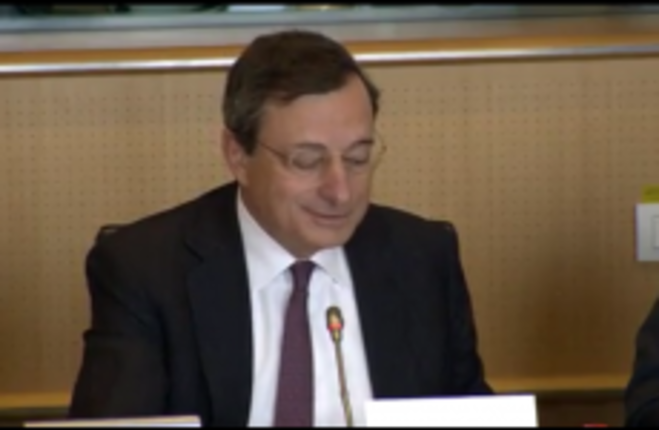
Mario Draghi tells MEPs that the European Central Bank only checks ‘monetary financing’ operations once a year

Mario Draghi:
Mario Draghi: "The Governing Council didn't have to pass a judgment on this."
Image: European Parliament screen grab

Updated, 14:16

THE PRESIDENT of the European Central Bank has said his institution has not yet considered whether the arrangements between the Central Bank of Ireland and the Irish government are in breach of European law.

Mario Draghi also appeared to differ from the Department of Finance on his understanding of the deal – saying the deal to swap promissory notes for Irish government bonds would see the Central Bank of Ireland sell the bonds as soon as it could.

Speaking to the Economic and Monetary Affairs Committee of the European Parliament, Draghi said the meeting of the ECB’s Governing Council earlier this month did not need to formally approve the Irish arrangement because the ECB was not a party to it.

“This is a transaction between the Irish government and the Central Bank of Ireland,” Draghi said. “The Governing Council didn’t have to pass a judgment on this.”

He said, however, that the legality of the deal – and whether it was in breach of the EU treaties, which forbid central banks from creating money to assist individual governments – had not yet been appraised.

“It will do so, however, in the context of the yearly assessment of monetary financing situations in the different banks and the different members of the Eurosystem.”

Draghi later said that if it was determined that the deal was illegal, the ECB would “see what remedial legal action has to be taken”.

A spokesman for the ECB told TheJournal.ie this afternoon that those appraisals are usually carried out when the ECB’s annual report is compiled in spring each year.

This would indicate that no authoritative test on the legality of the Irish deal might not be undertaken for another 12 months.

“There will be a time where there will be an assessment from the perspective of Article 123 [the article which bans 'monetary financing' by central banks] but not at this point in time,” Draghi told MEPs.

Draghi and Dublin differ on disposal

Speaking positively of the Irish deal, Draghi said the arrangement had eliminated a “huge” system of emergency loans to Irish banks “which had been going on for many years”.

“From this viewpoint, the [emergency lending] has disappeared and there are some tradeable government bonds,” he said.

However, in what could be a crucial differing between the ECB and the Irish government, Draghi said the Central Bank of Ireland would sell its €25 billion of government bonds – obtained in exchange for the promissory notes – “as soon as possible, compatible with financial market stability”.

This is dramatically different from the Department of Finance’s documentation on the deal, which claims there are annual limits on the volume of bonds that the Central Bank would sell every year.

Limits imposed by Ireland mean the Central Bank can only sell €2.5 billion of bonds before the end of 2018, with €1 billion each year thereafter until 2023 and a limit of €2 billion a year from 2024 onward. As a result, the Central Bank could not finish selling off the bonds until 2023.

This is crucial for Ireland, because the government will only pay an effective interest rate of 0.75 per cent on the bonds for as long as they are held by the Central Bank – whose profits are eventually returned to the Exchequer anyway.

Draghi acknowledged that the “disposal policy of the Central Bank of Ireland of these bonds” would be “crucial in the future”.

The Central Bank, responding to the deal two weeks ago, had also said the bonds would be sold “as soon as possible, provided that conditions of financial stability permit” – but that it would do so in full compliance with the rules that block central banks from funding governments.

Read: German central bank says promissory note deal is ‘problematic’

Read next:

Comments (34 Comments)

  • In December 2008, Rafael Correa (re elected president of Ecuador) declared Ecuador’s national debt illegitimate, based on the argument that it was odious debt contracted by corrupt and despotic prior regimes. He announced that the country would default on over $3 billion worth of bonds; he then pledged to fight creditors in international courts and succeeded in reducing the price of outstanding bonds by more than 60%.

    Why can’t our politicians look at other examples and follow an example of the courage of a developing nation !

    Reply
    • Thats cause u only get to the top in FF/FG/Lab if you’re a yes man or in other words, you do as your f**king told.

      Reply
    • Sounds like Rafael had 2 things, Vision and Cajones. The shower that lied to get into government have neither.

      Adebayo out

      Reply
    • They are looking at the examples of other countries, @Eco, and they have chosen the American example of corporate greed and political corruption.

      But seriously, you are not giving them enough credit. Our European politicians have created a higher level of political corruption that operates outside the laws of individual nations. It answers to no one and doesn’t require it’s members to actually do anything. They call it the EU.

      Reply
    • Well i suppose Rafael Correa had guts and so did the people of Ecuador along with knowing their rightr that’s the difference.

      Reply
    • Well i suppose Rafael Correa and the people of Ecuador have guts along with knowing their Rights that’s the difference.

      Reply
    • Because they are a bunch of spineless cretins!

      Reply
    • Deco 18/02/13 #

      Lucinda cretins :-):-)

      Reply
    • Eco
      The answer is simple. As a developed Nation and a Member of the European Union we would see our Foreign Direct Investment nosedive if we behaved like a South American Dictatorship and even worse there would be no future arrangement in respect of our Bank debts. At the same time the interest rate on Government Bondsnwhich we cannot avoid would once again go through the roof.mi trust that answers your question.

      Reply
    • The 1924 Dawes Plan and the 1929 Young Plan reduced the debt owed by Germany post WW1 substantially and granted Germany loans to meet its payments.
      Germany only ever paid about 1/8th of the reparations due for WW1 and believe it or not the final payment was made in September 2010!
      Post WW2 the vast majority of the original reparations were written off and granted Germany loans to meet its payments.
      Following the German occupation of Greece in WW2 Greece received mainly material goods in reparation — such as machines made in West Germany — worth approximately $25 million, which in today’s money amounts to as much as $2.7 billion.
      Under the terms of the 1953 London Debt Agreement, WW2 reparation payments were put off until a peace treaty was signed. That finally happened in 1990, which didn’t require Germany to pay further reparations to other countries like Greece.
      Post WW2 Germany didn’t really have to pay any reparations for a war that Germany started as the US imposed economic strictures on any agreed reparation amounts
      Greece hasn’t invaded anyone including Germany

      Reply
    • Excellent post George…demonstrates a two tier Europe clearly

      Reply
    • Would just like to throw in the key phrase “bank debts”! Why do people feel it is our debt?

      Reply
    • Because this Government are trying to impress EUROPEAN LEADERS instead of doing the right thing by Irellands People a

      Reply
  • Rushed ” middle of the night ” legislation has put these promissory notes onto our sovereign debt. FG=FF

    Reply
  • The ECB don’t give a damn about whether its legal or not. They have gotten away scott free with forcing Ireland to prop up bust banks and have now witnessed the Irish government turning the illegal notes used into sovereign debt. You could see the look on Draghis face last week, he literally couldn’t believe either his luck or the stupidity of our government. The ECBs off the hook and we are most definitely on it. We saved their banking system and our grandkids will still be paying as a result.

    Reply
  • Fine give us back the promissory note and let it go to the supreme court!

    Reply
  • So we haven’t got a deal. Period. We have a halfway house scam that’s not even a good scam. Seriously, we’re going to pay a family house tax to bail out these bozos?

    Reply
  • If the E.C.B. say that the deal is between the Irish govt. and our central bank , then what are these words about the govt. having an arrangement with the E.C.B. …. Working on it since August ? …what August is that?; August in Nevernever Land?

    Reply
  • Ive a funny feeling this is gonna come back and bite us on the hole.

    Reply
  • mattoid 18/02/13 #

    Am I missing something here? Since when did Mario Draghi get to decide whether something is legal or not? I know our EU masters have been trying to make themselves all-powerful, but surely it is up to a court to decide on the legality or otherwise of any deal…

    Reply
    • Mattie
      You are missing something! Draghi doesn’t get to decide whether the Promissory note treatment is legal or not. That would have to be determined by the European Courts but the real danger for the EU if such were to arise that Ireland might default on the debt as a quid pro quo as the only reasonable alternative to the extension of the debt term.

      Reply
    • mattoid 18/02/13 #

      Richard, obviously my question was meant to be rhetorical, not to be taken literally! It was more of a statement on the arrogance of the ECB and the disdain shown towards Ireland in recent times.

      Reply
    • Richard, did you give yourself a green thumb?

      Ya lil scamp ya

      Reply
  • They have taken our fools to the cleaners and they don’t care whether their regulations were broken or not for our fools have turned Their problem into Our problem.

    Reply
  • Sounds like the ECB are draghing their heels.

    Reply
  • Really? Hadn’t considered it even a little bit? Or maybe asked someone? I call bullsh1t..

    Reply
  • duzB 18/02/13 #

    Is it a “deal” or not a deal? Just heard on radio that it will take several months to decide? This nonsense only gets worse!
    Scrap the whole thing and tell them to FCUK off – not our debt!

    Reply
  • Paul D 18/02/13 #

    The ECB can kiss my ass.

    Reply
  • sean 18/02/13 #

    The whole thing stinks of corruption , FG,FF,LAB and ECB are knee deep in the middle of it ,
    Give me the equador dictatorship over the FG,ECB dictatorship anyday

    Reply
  • Nydon 18/02/13 #

    It’s all down to language difficulties. Our guys assumed that the ECB guys spoke the same dialect of winkandnod as they do. Turns out not be the case.
    The ECB guys don’t get the “Irish solution to an Irish problem” concept and so failed to join in.
    Now it looks like it is going to be just an “Irish solution to a European problem”.

    Reply
  • The EU hold the Irish in absolute contempt – the arrogance in their treatment is as breathtaking as the incompetence of those representing Ireland.

    Reply

Add New Comment