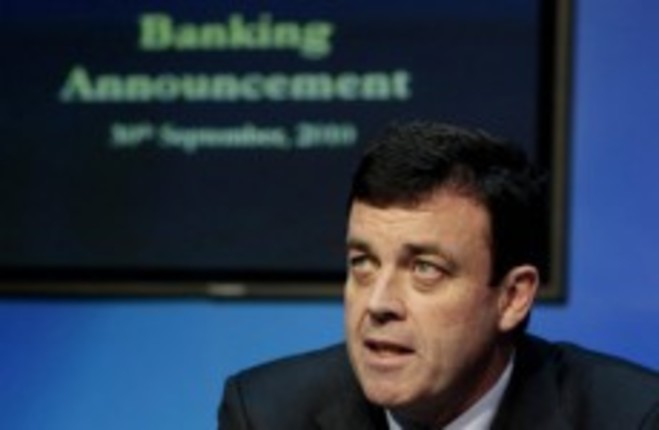
AN OPINION POLL published this morning shows that more voters would trust the European Central Bank or the International Monetary Fund to manage the country’s finances than they do Ireland’s own politicians.
A Red C poll published in this morning’s Irish Sun shows that 30% of respondents saw the ECB as capable of making the spending cuts needed to haul the country’s finances back on track, while 29% expressed the same faith of the IMF.
By comparison, only 28% of voters believe current Minister for Finance, Brian Lenihan, is capable of solving our economic woes.
Lenihan still ranks ahead of the opposition finance spokespersons, however – and in yet another embarrassing poll performance for Fine Gael, Michael Noonan trails Labour’s Joan Burton in terms of commanding public confidence.
23% of those surveyed said they believed Burton was capable of managing the economy, while Noonan scored just 21%.
When asked who they thought was least capable of bringing in real financial reform, the ECB and IMF again scored best – with 37% of respondents unconvinced of each body’s ability.
Of the three politicians, however, Brian Lenihan scored worst: 48% of respondents said they did not trust him to clean up the country’s finances, while Noonan was disapproved of by 46% and Burton by 44%.
Spending cuts
Elsewhere, the poll also asked voters where they felt the government should make spending cuts or find new revenue in this December’s budget – reported yesterday by the Sunday Times to total €4.6bn in cuts or new income.
Over half – 56% – of the 1,005 respondents surveyed said the public sector pay bill should be cut, with 22% opposed; 55% said capital spending – construction of new train lines and roads – should face cutbacks, to the opposition of 16%; while 52% of respondents felt the ‘old reliables’ of fuel, cigarettes and alcohol should be targeted for another increase in excise duty, a move opposed by 20%.
In what could be a significant move, 42% of those asked said income tax should be raised – a move disapproved of by 27% of voters. Meanwhile, the proposition of cutting social welfare was the most equally divisive: 40% of voters approved, and 40% disapproved.


Just click Like.