Business ETC uses cookies. By continuing to browse this site you are agreeing to our use of cookies. Click here to find out more »
Dublin: 13 °C Tuesday 21 May, 2013

Average house price now under €200k – and there’s still room to fall

Daft.ie report shows property price fall accelerated in second quarter of 2011. Asking prices nationally fell 5 per cent in three months.

Image: BeingSelfEmployed.org via Flickr.com

ASKING PRICES FOR residential property fell an average of 5.1 per cent in three months, their steepest decline in 18 months.

The Q2 report by daft.ie on national property prices shows that the average asking price is now half what it was in the peak of 2007.

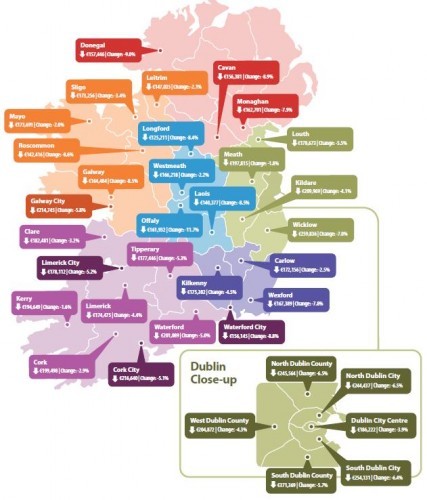
The county with the steepest decline in prices between Q1 of 2011 (the period January to March) and Q2 (the period April to June) is Offaly. It experienced an 11.7 per cent drop over the last three months. Donegal, (down 9 per cent), Cavan (down 8.9 per cent and Waterford City (down 8.8 per cent) had the next largest drops.

Dublin experienced an average of 5.7 per cent in prices over the three months of April, May and June, with Cork, Galway and Limerick cities suffering similar drops of between 5 and 6 per cent.

While all counties experienced an overall drop in residential property prices, some such as Kerry (1.6), Meath (1.8), Mayo (2 per cent), Leitrim (2.1), Westmeath (2.2) and Carlow (2.5) had a much lower rate of decline.

Constantin Gurdgiev, head of research and strategy for St Columbanus IA, said that the data in the daft.ie report “clearly shows that there is some room for continued significant losses in residential real estate”. He said:

Across all geographies covered in today’s report, asking prices continued to fall and these falls are accelerating once again. Nationwide, asking prices are down 5 per cent in three months through June 2011 – the steepest quarterly decline in 18 months.

In an introduction to the report he said that several factors were combining to hamper economic recovery and meant a “bleak forecast for Irish property markets both commercial and residential going forward”. The “vicious cycle of low yields and collapsing capital gains still has room to run before Irish property markets can see a sustained stabilisation,” he said.

Daft.ie economist Ronan Lyons said that at a very basic level, the “sheer volume of properties” and the difficulty of securing a mortgage were weighing heavily on the market. He told TheJournal.ie:

One thing that has changed in the last few months is the introduction of distressed property auctions which have begun to show what the realistic price level is. The fall in prices has sped up in the last couple of months and that could be increased realism on the part of sellers.

Lyons said that Dublin city centre could stabilise as early as the first half of next year. Prices there fell by 3.9 per cent in the last three months but this was a smaller fall than in other areas of the capital.

Some of the figures in the daft.ie Q2 report for 2011 include:

  • Prices in Dublin in June were 51 per cent lower than they were in mid-2007; in Limerick, prices went down by just one-third in the same period.
  • Around 60,000 properties are for sale in the country.
  • However, houses are staying on the market on average one month LESS than they did in Q1. But the wait to sell differs vastly across the country, ranging from four months in Dublin to up to 14 months in Connaught and Ulster.
  • The year-on-year fall in asking prices was 16.5 per cent in June, up from 14 per cent last November.
  • The average asking price for a three-bed house ranges from €349,000 in south Co Dublin to €119,000 in Roscommon.
  • The average price of a residential property in June was €196,000 – that’s down 47 per cent from 2007.
  • On a province-by-province breakdown, asking prices in Leinster fell by eight per cent or more during the period of May to June. Time-to-sell has fallen from 10 months in Q1 to eight months. Asking prices in Munster fell by close to five per cent on average, with time-to-sell reducing from 12 months in late 2010 to nine months now. Connaught and Ulster saw sharp falls of between eight to nine per cent between Q1 and Q2. It takes longer to sell a house in these two areas than anywhere in the country – the average property sits on the market for just over a year.

This map shows the drop in the average residential property comparing Q1 with Q2 (Click here for bigger version):

Meanwhile, MyHome.ie also reported a steady decline in residential property prices in a report on stock on their website. The report found that asking prices are down by an average of just under eight per cent nationally in the first six months of the year. Angela Keegan, MD of MyHome.ie, found that the national asking price for a new home was €235,000, putting prices “back at levels last seen a decade ago”.

Read next:

Comments (11 Comments)

  • The prices on these websites are not what the houses are selling for. They seem to be selling for significantly less than the guide price.

    Reply
  • And while people are intellectually aware that property taxes, water charges, and higher interest rates are all coming (which should mean that their impact is already baked into property prices) it’s possible that their actual arrival will have another negative effect on sentiment and prices.

    Reply
    • Well yes, and you have to consider that
      a) self employed, contract and temporary workers are totally shut out of the market, possibly for a long time
      b) many people who were laid off and lucky enough to get another job will have to wait 3 years to even apply
      c) banks are now stringently applying normal lending criteria to joint incomes – no more throwing 200k mortgages at 30k per annum wage earners

      Average salaries are currently around 35k – median wages are probably lower. The only thing that is surprising is that rents haven’t fallen more – even with cuts in rent allowance and cash welfare cuts.

      Reply
  • The experts have no credibility, most that comment in the media on such issues have an invested interest in keeping the price high or trying to stop the fall in the market as most are involved in property in some way as are our politicians which explains the protectionism going on.

    However, it simply will not work as the market is showing and is slowing the correction. Politicians believe they can talk up anything as that is how they get elected and is essentially their trade.

    Nobody trusts these people anymore so properties will fall. Given Irish banks struggle to lend as it is, they will not lend for mortgages which means even when house prices appear good, people will still struggle to buy as they won’t get loans so many houses are going to end up either on the market for a long time or reducing to very low values so that people can get small loans or purchase without taking out a loan.

    This is even more likely to be true when you consider the new taxes coming and public sector cuts that will most likely cause many to fall behind on their mortgages and eventually banks will have to act on this as well as the people who have already fallen behind on payments (at this point we will have to reform bankruptcy law in this country). That will mean more houses on the market again.

    Prices may have dropped 50% but yes they have a long way to fall still. We are due an over correction in this market on top of this as many people seeing their families/friends buried in debt will simply not buy. If anybody had money to buy and didn’t own a house, this might seem like good news. With unemployment the way it is and the numbers who bought into the housing bubble, we have few of those people around.

    Reply
  • I reckon 1999 prices is where we’re headed. If they had carried on naturally with no stupid government intervention from there on, prices would have increased by about 14-18% now. The housing market will drop below that level because of the over supply conundrum. That, the over supply, won’t go away while emigration is happening. Predicting a time these falls will take is, quite frankly, both impossible and irresponsible while NAMA continues to meddle in the markets and the economy is at best flat and most likely in decline at least domestically. Time will tell to use a cliche.

    Reply
  • A house is only worth what people are willing to pay for it and at the moment it’s like an Italian food Market put there, some even offer half the asked price! Crazy.

    Reply
  • if they can,t get high price,s and stamp duty at inflated prices,it,s stealth tax market from now on

    Reply
  • The continued fall of property prices highlights the failure of NAMA. This is another ill-concieved government policy that will ultimately be paid for by the Irish taxpayer.

    Reply
  • The information on Daft is quite distorted. It doesn’t reflect issues such as sellers removing and reentering properties onto the site, or actual selling prices. It also doesn’t have any way to measure if sales went to sale agreed but then fell through. Likewise the rental section can sometimes be full of properties that are not actually for rent at all, just basically acting as “teasers” – I’ve noticed that some agencies actually regenerate a single ad several times for the same property!

    To get an accurate picture of what is going on you’d need to measure a number of different sources – advertised prices, newspaper and “shop windows”, mortgage applicants, some input from those who would “like to buy” but cannot.

    Information on the Daft.ie reports is very biased and circumspect, and getting celebrity economists to write them is merely an endorsement of both this and those celebs mediocrity.

    Reply
  • NAMA is not shifting its stock of housing so the market cannot fall to its natural level,it should not be trying to make the market “stable” by not releasing the housing stock it now owns.In my opinion NAMA aims to keep property prices unnaturally high,which is not good for the economy in the long run,its logic being that property prices should not be allowed to drop further.

    Meddling in the market like this can only be bad,and is laying a foundation for another property bubble in the future.

    Reply

Add New Comment